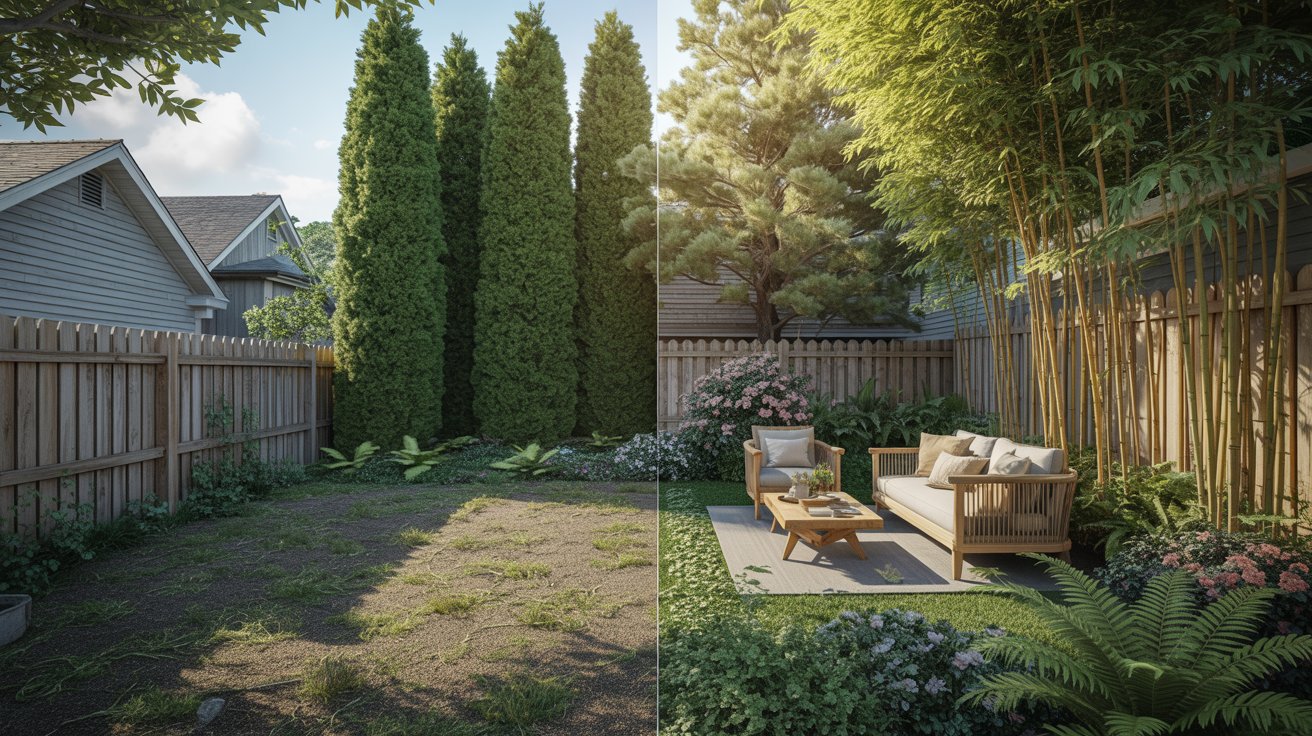
I still remember the moment I realized my backyard had zero privacy. I was enjoying my morning tea when I noticed my neighbor casually watching from their balcony—and suddenly, my “peaceful garden” didn’t feel so peaceful anymore.
At first, I thought a fence would fix everything. But fences can feel harsh, expensive, and honestly… not very beautiful. What I really wanted was something lush, natural, and calming.
That’s when I discovered the secret: the right privacy trees can transform even the smallest backyard into a secluded retreat—fast.
Some grow taller than fences in just a couple of years. Others stay slim but dense, perfect for tight spaces.
What I really wanted was something lush, natural, and calming—similar to the ideas I shared in my guide on small backyard transformation ideas that make spaces feel bigger and more inviting (sprucetouch.com).
Below, I’ve shared my favorite tried-and-tested privacy trees that don’t just block views—they elevate your entire outdoor space.
Quick Selection Table (Top 5 Privacy Trees)
| Tree Name | Best For | Growth Speed | Space Needed | Bonus Feature |
|---|---|---|---|---|
| Emerald Green Arborvitae | Narrow spaces | Moderate | Slim | Year-round greenery |
| Bamboo (Clumping) | Fast privacy | Very Fast | Medium | Tropical vibe |
| Italian Cypress | Vertical elegance | Fast | Very Slim | Perfect for tight yards |
| Leyland Cypress | Full coverage | Very Fast | Medium-Large | Thick wall effect |
| Japanese Holly | Low hedges | Moderate | Small | Easy shaping |
1. Emerald Green Arborvitae – The Classic Privacy Wall
This was the first tree I ever planted for privacy, and honestly—it’s still my favorite for tight spaces. Emerald Green Arborvitae grows in a neat, column shape, so you don’t have to worry about it spreading too wide and eating up your precious backyard space.
When planting, space them about 2–3 feet apart if you want that dense “green wall” effect. I made the mistake of spacing mine too far initially, thinking they’d fill in faster—but that only delayed the privacy I was craving.
You can usually find these at local nurseries or even budget garden centers. If you’re looking to save money, buy smaller plants—they establish quickly and catch up fast with proper watering.
The key here is consistency. Water deeply in the first year and mulch around the base to retain moisture. That alone can double how fast they grow.
Mistake to avoid: Don’t plant them in soggy soil—they hate wet roots and can turn brown quickly.
2. Clumping Bamboo – Instant Jungle Privacy
If you want privacy yesterday, bamboo is your answer. But—and this is important—always choose clumping bamboo, not running bamboo. I learned this the hard way after seeing a neighbor struggle with invasive roots.
Clumping bamboo grows in tight clusters and can shoot up several feet in a single season. It’s perfect for creating that lush, tropical feel, even in a small backyard.
Plant it in large containers if you’re worried about control. This also makes it easier to move around if you redesign your space later.
You can find affordable bamboo at local plant markets or even online garden stores. Look for healthy green stalks and avoid yellowing leaves.
If you love that dense, calming greenery, you’ll also enjoy exploring biophilic balcony garden ideas that bring nature into compact spaces (sprucetouch.com), where layering plants creates that same immersive effect.
Mistake to avoid: Never skip root barriers if planting in-ground—it can spread faster than expected.
3. Italian Cypress – Tall & Elegant Privacy
Italian Cypress feels like something straight out of a Mediterranean villa—and surprisingly, it works beautifully in small backyards.
What makes this tree special is its vertical growth. It grows tall without spreading wide, making it ideal for lining boundaries where space is limited.
I recommend planting them in a straight line for a dramatic effect. Even 3–4 trees can make a huge difference visually and functionally.
They prefer full sun and well-drained soil. If you’re in a hotter climate, they’ll thrive with minimal effort.
Mistake to avoid: Don’t overwater—these trees prefer slightly dry conditions.
4. Leyland Cypress – The Fast Privacy Giant
If speed is your top priority, Leyland Cypress is unbeatable. These trees grow incredibly fast and create a thick, dense barrier in just a couple of seasons.
I’ve seen people transform completely exposed yards into private sanctuaries in under two years using these.
They do need a bit more space compared to slim trees, so plan accordingly. Regular trimming helps keep them manageable and encourages fuller growth.
You can often get these at bulk discounts if you’re planting multiple trees—worth asking your nursery.
Mistake to avoid: Skipping pruning—these can quickly get out of control if left unattended.
5. Japanese Holly – Compact & Tidy
Japanese Holly is perfect if you want privacy without towering trees. It’s more of a shrub-like tree but incredibly effective for low screening.
It’s easy to shape, so you can maintain a clean, polished look. I love using it along pathways or patios where full-height trees would feel overwhelming.
It grows best in partial to full sun and doesn’t require constant maintenance—perfect for beginners.
Mistake to avoid: Over-trimming too early—let it establish before shaping.
🌟 PRO TIP (Privacy Boost Hack)
Layer your privacy instead of relying on one type of tree.
Combine tall trees like cypress with medium shrubs and low hedges. This creates a multi-level barrier that blocks views more effectively and looks more natural. Plus, it adds depth and makes your backyard feel bigger—not closed in.
6. Thuja Green Giant – The Low-Maintenance Shield
If you’re someone who doesn’t want to fuss over plants constantly, Thuja Green Giant is a lifesaver. This tree grows incredibly fast—sometimes up to 3 feet per year—and once established, it pretty much takes care of itself.
I often recommend this to beginners because it’s forgiving. Miss a watering here and there? It won’t punish you immediately like fussier plants.
Plant them about 5–6 feet apart if you want a thick privacy wall. They’ll fill in quicker than you expect, especially with a bit of compost mixed into the soil during planting.
One trick I’ve used is planting them slightly staggered instead of in a straight line. It creates a denser, more natural screen that looks professionally landscaped.
You can find these at most nurseries at reasonable prices, especially in bulk packs. Smaller sizes are much cheaper and grow surprisingly fast with the right care.
Mistake to avoid: Don’t plant too close together—they need airflow to prevent disease.
7. Red Tip Photinia – A Pop of Color + Privacy
If you’re tired of plain green privacy walls, Red Tip Photinia is such a refreshing change. The new leaves come in a bright red shade, which slowly matures into deep green—so your hedge always looks dynamic and alive.
I’ve used this in a client’s small backyard where they wanted both privacy and visual interest. Instead of a boring wall of green, this gave them a layered, almost decorative feel without sacrificing coverage.
Plant them about 4–5 feet apart and let them grow naturally for a while before shaping. They respond really well to pruning, so you can keep them as a hedge or let them grow slightly taller for better screening.
Budget tip: these are often cheaper than conifers at local nurseries, especially in medium sizes. You can also propagate them from cuttings if you’re patient—it’s a great way to save money long-term.
Mistake to avoid: Don’t overcrowd them—poor airflow can lead to leaf spot disease.
8. Ficus Nitida – The Dense Privacy Wall
Ficus Nitida is one of those plants that feels almost too good to be true for privacy. The leaves grow dense and close together, creating a near-solid green wall when maintained properly.
I’ve seen this used beautifully in compact urban homes where neighbors are just a few feet away. Once it fills in, you genuinely can’t see through it—even at eye level.
Plant them close (around 2–3 feet apart) for faster coverage. Regular trimming encourages bushier growth, which is exactly what you want for privacy.
If you’re on a budget, start with smaller plants and commit to trimming early—it helps them thicken instead of just growing tall and sparse.
Mistake to avoid: Don’t let them grow unchecked early—they can become top-heavy instead of dense.
9. Podocarpus – The Elegant Hedge Alternative
Podocarpus has this soft, feathery texture that instantly makes a garden feel more refined. It’s not as rigid as traditional hedges, which is why I love it for modern or minimalist spaces.
It grows upright but can be shaped easily, so you can decide whether you want a natural look or something more structured. I usually recommend it for people who want privacy without making their backyard feel boxed in.
Plant it along fences or walls where you want coverage but still want light to filter through slightly. It’s also great for layering with other plants.
You can often find affordable podocarpus in garden centers, and it grows steadily with basic care. Just ensure it gets enough sunlight.
Mistake to avoid: Don’t plant in heavy shade—it becomes thin and leggy.
10. Oleander Trees – Flowering Privacy Screen
Oleander is one of those rare plants that gives you both privacy and flowers. If you want your backyard to feel more like a retreat than a barrier, this is a great option.
I’ve used oleander along boundary walls where people wanted something less “hedge-like” and more decorative. The blooms add color, while the foliage stays dense enough to block views.
They’re drought-tolerant once established, which makes them perfect for low-maintenance gardens. You’ll find them easily at local nurseries, often at very reasonable prices.
Plant them in sunny spots and give them room to grow slightly outward—it helps create that lush, full look.
Mistake to avoid: Be mindful—oleander is toxic if ingested, so avoid if you have pets or small children.
11. Wax Myrtle – Fast & Fragrant Privacy
Wax Myrtle is one of those underrated gems. It grows quickly, fills in beautifully, and even releases a subtle fragrance when the leaves are brushed.
I’ve recommended this to homeowners who want privacy but also enjoy sensory elements in their garden. It’s especially nice near seating areas where you can appreciate the scent.
Plant them about 4–6 feet apart and let them grow naturally before trimming. They’re adaptable and can handle different soil types, which makes them beginner-friendly.
They’re often available at budget prices in local nurseries, especially in regions with warm climates.
Mistake to avoid: Don’t skip pruning entirely—light trimming keeps them dense and effective for privacy.
🌟 PRO TIP (Dense Privacy Trick)
Trim early, not late.
Most people wait too long to prune their privacy trees—but early trimming actually encourages bushier growth. A light trim in the first year can make your screen twice as dense later.
This layered approach is very similar to what I’ve used in backyard lighting and layout strategies that make small gardens feel intentional and designer-like (sprucetouch.com), where depth plays a huge role.
12. Cherry Laurel – The Glossy Privacy Shield
Cherry Laurel is one of the best choices if you want a strong, evergreen privacy wall. The leaves are large, glossy, and grow tightly together—perfect for blocking views quickly.
I’ve used this in backyards where neighbors are very close, and within a couple of seasons, it created a near-complete visual barrier.
Plant them about 3–4 feet apart for a dense hedge. They respond well to pruning, so you can keep them at your desired height without much trouble.
They’re widely available and relatively affordable, especially if you buy younger plants.
Mistake to avoid: Don’t plant in waterlogged soil—it can cause root issues.
13. Privet Hedge – The Budget-Friendly Screen
If you’re working with a tight budget, privet is honestly one of the best options out there. It grows quickly and can be shaped into a dense hedge without much effort.
I’ve seen entire backyard boundaries transformed with privet for a fraction of the cost of other trees. It’s especially great if you need a long privacy line.
Plant them close—about 2–3 feet apart—and trim regularly to encourage thickness. This is one plant where consistent shaping really pays off.
You can often find them in bulk deals at nurseries, making them even more affordable.
Mistake to avoid: Don’t skip maintenance—privet can look messy if left untrimmed.
14. Sky Pencil Holly – Ultra-Slim Privacy Solution
If your backyard is really small, Sky Pencil Holly is a game-changer. It grows tall and extremely narrow—almost like a living column.
I love using this near patios, decks, or narrow side yards where traditional trees just won’t fit. Even a few of these can create a noticeable privacy effect.
Plant them about 1–2 feet apart for a tighter look. They don’t need much pruning, which makes them low-maintenance.
You can usually find them at garden centers in compact sizes, and they’re perfect for container planting too.
Mistake to avoid: Don’t plant in heavy shade—they need sunlight to maintain their shape.
15. Carolina Cherry Laurel – Fast, Tough & Reliable
If you want something that just works without constant attention, Carolina Cherry Laurel is a solid pick. It’s incredibly tough, adapts well to different soils, and creates a thick privacy wall faster than most people expect.
I’ve used this in a backyard where the soil quality was honestly… not great. Still, within two seasons, it formed a dense green screen that blocked out a neighboring building completely.
Plant them about 3–4 feet apart and water consistently in the first year. After that, they become surprisingly drought-tolerant. A layer of mulch helps lock in moisture and speed up growth.
They’re usually cheaper than premium hedging plants, especially when bought in bulk. If you’re planting a long boundary, this can save you a lot.
Mistake to avoid: Don’t ignore early shaping—light pruning helps it fill out faster instead of growing unevenly.
16. Golden Bamboo (Controlled) – Bright & Bold Privacy
Golden bamboo adds a completely different vibe compared to typical green screens. The yellow-golden canes catch sunlight beautifully, making your backyard feel brighter and more dynamic.
Now, here’s the key: this is a running bamboo, so you need to control it. I recommend planting it in containers or installing a proper root barrier. Done right, it’s one of the fastest privacy solutions out there.
I’ve seen it used along modern patios where homeowners wanted both privacy and a design statement—and it absolutely delivers.
You can often find it at good prices in local plant markets. It grows so fast that even smaller plants become impressive quickly.
Mistake to avoid: Never plant directly in-ground without containment—it can spread aggressively.
17. Japanese Maple (Layered Privacy)
This might surprise you—but Japanese Maple can actually help with privacy when used creatively. Instead of a solid wall, it provides filtered privacy, which feels softer and more natural.
I love placing these near seating areas or patios where you don’t want a harsh barrier. The delicate leaves create a beautiful canopy that partially blocks views while still letting light through.
For better coverage, combine it with shrubs or low hedges underneath. This layered approach looks high-end and feels intentional.
These can be a bit pricier, but even one well-placed tree can elevate your entire backyard. Look for smaller varieties if you’re working with limited space.
Mistake to avoid: Don’t plant in harsh afternoon sun—it can scorch the leaves.
18. Areca Palm – Tropical Privacy Vibes
If you want your backyard to feel like a resort, Areca Palm is the way to go. It grows in clusters, creating a soft, feathery screen that’s surprisingly effective for privacy.
I’ve used these in container setups along patios, and they instantly transformed the space into something more relaxed and private. Plus, they’re great for small backyards because they don’t feel heavy or overwhelming.
Plant them in large pots for flexibility—you can rearrange them as needed. They thrive in bright, indirect sunlight and regular watering.
They’re widely available and often affordable, especially in medium sizes.
Mistake to avoid: Don’t let the soil dry out completely—they prefer consistent moisture.
19. Eucalyptus – Fast Growth with a Modern Look
Eucalyptus is one of those trees that instantly gives your backyard a modern, designer feel. The silvery-green leaves and upright growth make it both functional and stylish.
It grows quickly, especially in sunny spots, and works well as a loose privacy screen rather than a dense hedge. I like using it where you want partial privacy without blocking all light.
Plant it slightly away from structures since it can grow tall. Regular pruning helps maintain a manageable size and encourages fuller growth.
You can often find young eucalyptus plants at reasonable prices, and they establish quickly with proper care.
Mistake to avoid: Don’t ignore its size potential—it can outgrow small spaces if left unchecked.
20. Hibiscus (Tall Varieties) – Privacy with Blooms
Tall hibiscus varieties are such a fun way to create privacy without making your yard feel closed off. The flowers bring life and color, while the foliage adds just enough coverage.
I’ve seen these used along fences where homeowners wanted a more cheerful, welcoming look instead of a solid green wall. It works especially well in sunny climates.
Plant them close together for better screening, and prune lightly to encourage bushier growth. They respond well to feeding, so a bit of fertilizer goes a long way.
They’re easy to find and budget-friendly, making them a great option for beginners.
Mistake to avoid: Don’t skip sunlight—hibiscus needs full sun to bloom properly.
GROWING SECRET (Layering Like a Pro)
Mix textures for better privacy and aesthetics.
Combine dense hedges (like laurel) with airy trees (like eucalyptus or palms). This not only blocks views more effectively but also makes your backyard feel professionally designed instead of crowded.
21. Magnolia ‘Little Gem’ – Compact Luxury Privacy
If you want something that feels a bit more “premium,” Little Gem Magnolia is a beautiful choice. It stays relatively compact but still provides solid privacy with its dense, glossy leaves.
What makes it special is the large white flowers—it turns your privacy screen into a feature. I’ve used this in smaller backyards where homeowners wanted both function and a focal point.
Plant them about 4–5 feet apart and give them room to grow upward. They prefer well-drained soil and consistent watering during the early stages.
They can be slightly more expensive, but even a few strategically placed trees can make a big impact.
Mistake to avoid: Don’t rush growth with too much fertilizer—it can stress the plant.
Deep Authority Section
❓ FAQ (People Also Ask)
1. What is the fastest-growing privacy tree for small backyards?
Clumping bamboo and Leyland cypress are among the fastest, often growing several feet per year.
2. How close should I plant privacy trees?
It depends on the variety, but generally 2–6 feet apart for dense coverage.
3. Can I grow privacy trees in pots?
Yes—especially bamboo, arborvitae, and smaller shrubs.
4. How long until I get full privacy?
With fast-growing trees, you can achieve decent coverage in 1–3 years.
5. Do privacy trees require a lot of maintenance?
Most require minimal care once established—mainly watering and occasional pruning.
Seasonal Maintenance Calendar
- Spring: Fertilize, prune lightly, check soil health
- Summer: Deep watering, monitor growth
- Fall: Add mulch, trim for shape
- Winter: Minimal care, protect young plants
Common Mistakes to Avoid
- Planting too close together
- Ignoring sunlight requirements
- Overwatering or underwatering
- Choosing invasive species
- Skipping pruning
Final Thoughts
Creating privacy in a small backyard isn’t about building walls—it’s about growing them.
I’ve found that the right mix of trees not only blocks unwanted views but completely changes how a space feels. It becomes calmer, more personal, and honestly… more yours.
Start small if you need to. Even planting just 2–3 of the right trees can make a noticeable difference within a single season.
And once that green wall starts filling in? You’ll wonder why you didn’t do it sooner.
Once you start building privacy with plants, you’ll naturally want to upgrade the rest of your space too—like adding elements from budget-friendly backyard upgrades that instantly improve outdoor living (sprucetouch.com).

Aagam – Founder of SpruceTouch
Aagam is a home and garden enthusiast who shares practical ideas for backyard design, garden projects, patio decor, and small outdoor spaces. Through SpruceTouch, he focuses on simple and budget-friendly ways to improve outdoor living spaces.