DIY Garden Paths: Why I stopped using mulch and switched to repurposed stones
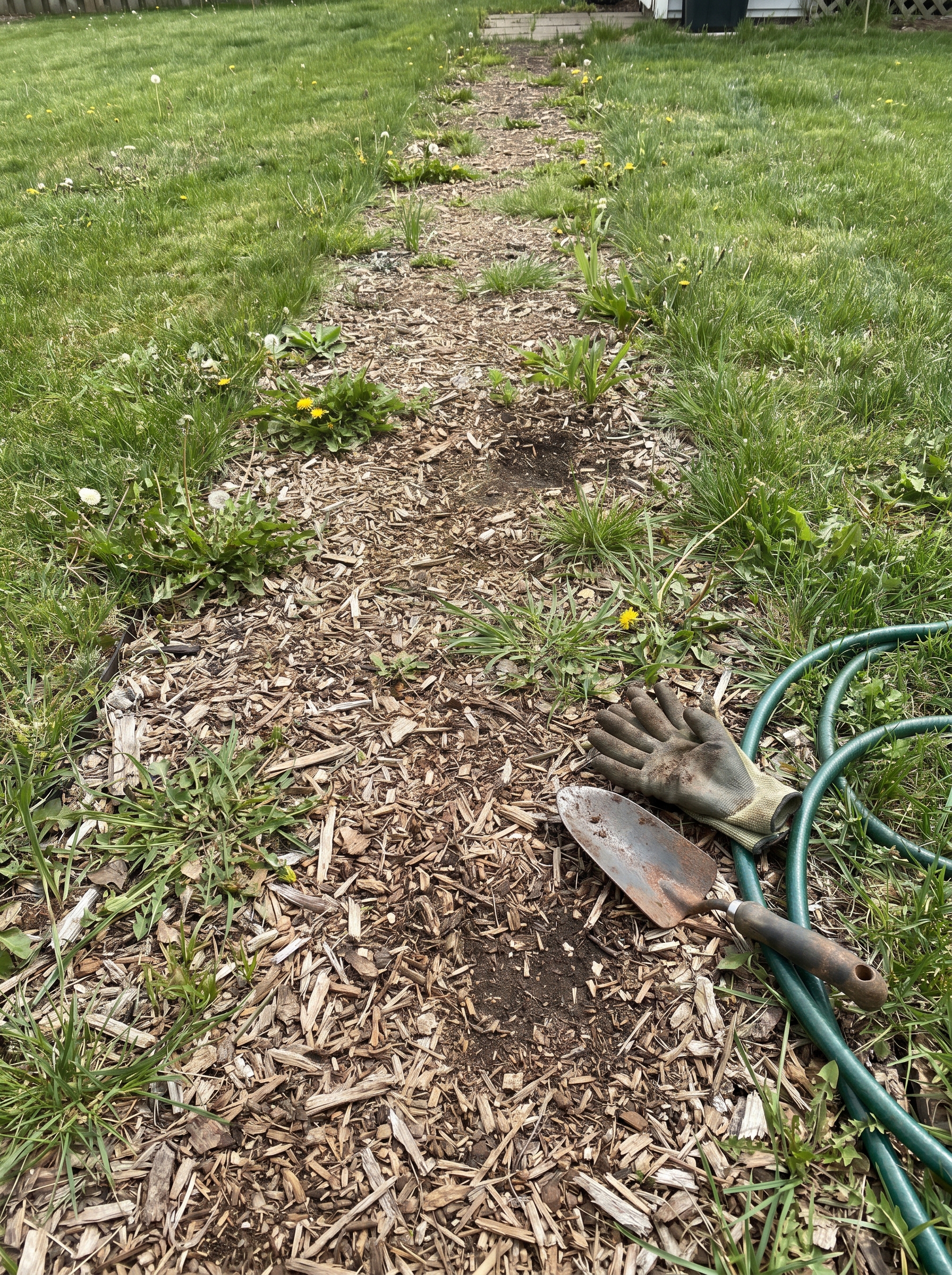
If you’ve spent more than two seasons hauling two-cubic-foot bags of shredded hemlock bark out of the trunk of your hatchback, you already know the dirty secret of wood chip pathways. They look crisp for about three weeks. Then the summer rain hits, the organic matter breaks down into rich black humus, and by mid-July, your foot traffic path becomes the single most productive weed nursery in your entire yard.
I spent six years paying what I call the annual “mulch tax”—roughly $180 every April for 30 bags of shredded bark—before I realized I was literally paying money to grow crabgrass, chickweed, and creeping Charlie. After one particularly violent spring thunderstorm turned my primary garden walkway into a four-inch-deep slurry of rotting wood soup, I quit mulch for good.
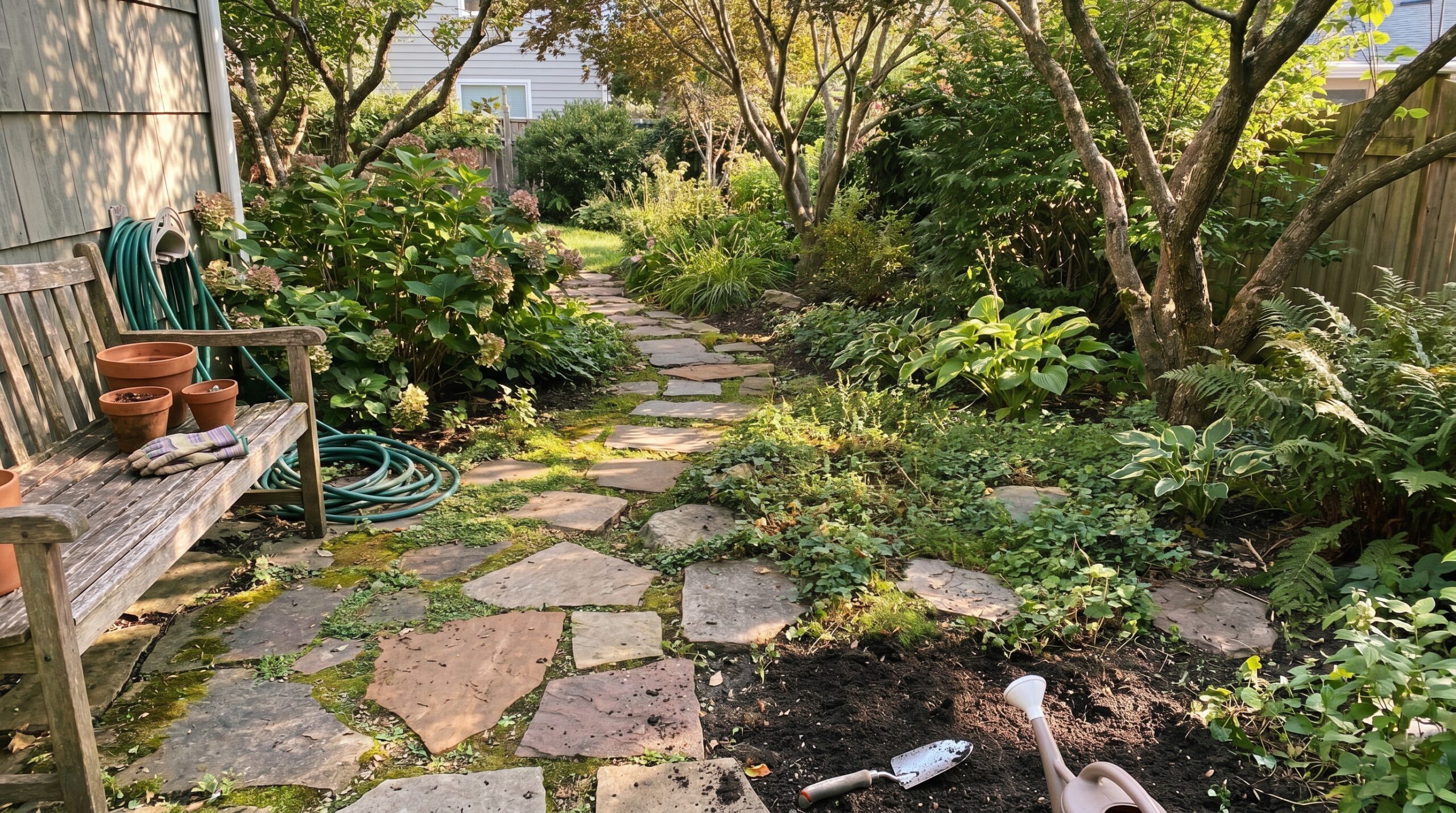
Here is how I replaced 45 linear feet of washed-out, soggy wood chip paths with a permanent, zero-material-cost walkway using scavenged fieldstone and broken concrete slabs (urbanite). I’ll cover everything: the exact physical math of material sourcing, the sub-base preparation that prevents winter heaving, and the precise plant species that turn stone gaps into living art.
Disclosure: This post contains affiliate links. As an Amazon Associate, I earn from qualifying purchases at no extra cost to you.
1. The True Cost: Mulch vs. Scavenged Stone (The 5-Year Math)
When beginners build their first pathway, they usually look at the immediate price tag at the big-box home improvement store. A bag of mulch costs $4 to $6. A single flagstone paver costs $8 to $15. On paper, wood chips look like the undisputed financial winner.
That math breaks down completely once you look at a five-year timeline. Organic pathways are dynamic systems—they don’t just stay where you put them. They decompose, they blow away during leaf-blowing, and they stick to the mud on your work boots.
Here is how the real costs compare over five years for a standard 3-foot-wide by 30-foot-long garden path (90 square feet):
| Path Material | Initial Material Cost | Annual Top-Up Cost | 5-Year Material Total | 5-Year Labor Hours | Long-Term Weed Maintenance |
| Bulk Cedar/Hemlock Mulch | $85 (1.5 cubic yards) | $85 / year | $510 | ~20 hours hauling/raking | High (Weekly hand-weeding in rich rot) |
| Pebbles / Pea Gravel | $160 (Crushed stone) | $35 (Washed out gravel) | $300 | ~14 hours leveling/edging | Extremely High (Weeds root into silt gaps) |
| New Store-Bought Flagstone | $450 – $700 (Pallet) | $0 | $450 – $700 | ~16 hours initial setup | Low (Gaps easily managed) |
| Scavenged Stone / Urbanite | $0 – $40 (Gas & Sand) | $0 | $0 – $40 | ~18 hours (Sourcing + Laying) | Minimal (With proper base prep) |
When you factor in the labor of shoveling 30 bags of wet mulch every spring, “cheap” wood chips suddenly become one of the most expensive landscaping choices you can make. Stone is heavy, and sourcing it takes patience, but once those slabs are set into a solid base, you are done. Forever.
2. Why Wood Chips Fail (The Science of Pathway Decomposition)
To understand why stone is superior, you have to look at soil microbiology. Wood chips are rich in carbon. When you lay a three-inch layer of wood chips over bare soil, fungal hyphae and soil bacteria quickly colonize the bottom layer where moisture stays trapped against the earth.
As these microorganisms break down the wood fibers, they convert coarse chunks into fine, nitrogen-rich organic matter. In a garden bed around your shrubs, this is fantastic news. On a walkway, it is a disaster.
- The Silt Accumulation Trap: Within 12 to 18 months, the bottom inch of your mulch path turns into pure compost. Weed seeds carried by the wind don’t stay on top; they drop into the damp, nutrient-dense silt at the bottom and germinate rapidly.
- The Soil pH Shift: Constant wood decomposition creates an acidic surface layer that favors aggressive, shallow-rooted weeds like wood sorrel (Oxalis) and dandelion, which thrive in loose, moist organic matter.
- The Nitrogen Depletion Myth: People often say mulch starves weeds of nitrogen. While raw wood chips temporarily tie up nitrogen at the immediate surface contact point, the decomposing layer underneath quickly becomes a nutrient sponge once soil microbes settle in.
Simply put: a mulch path is not a barrier. It is a slow-motion compost pile that you walk on every afternoon.
The Complete 2026 Guide to Soil Health: How to Test and Fix Your Garden Soil at Home is a great read if you’re worried about how changing your path materials might affect the ground underneath, but for the path itself? Stone is king.
3. Scavenging 101: How to Source Tons of Free Stone
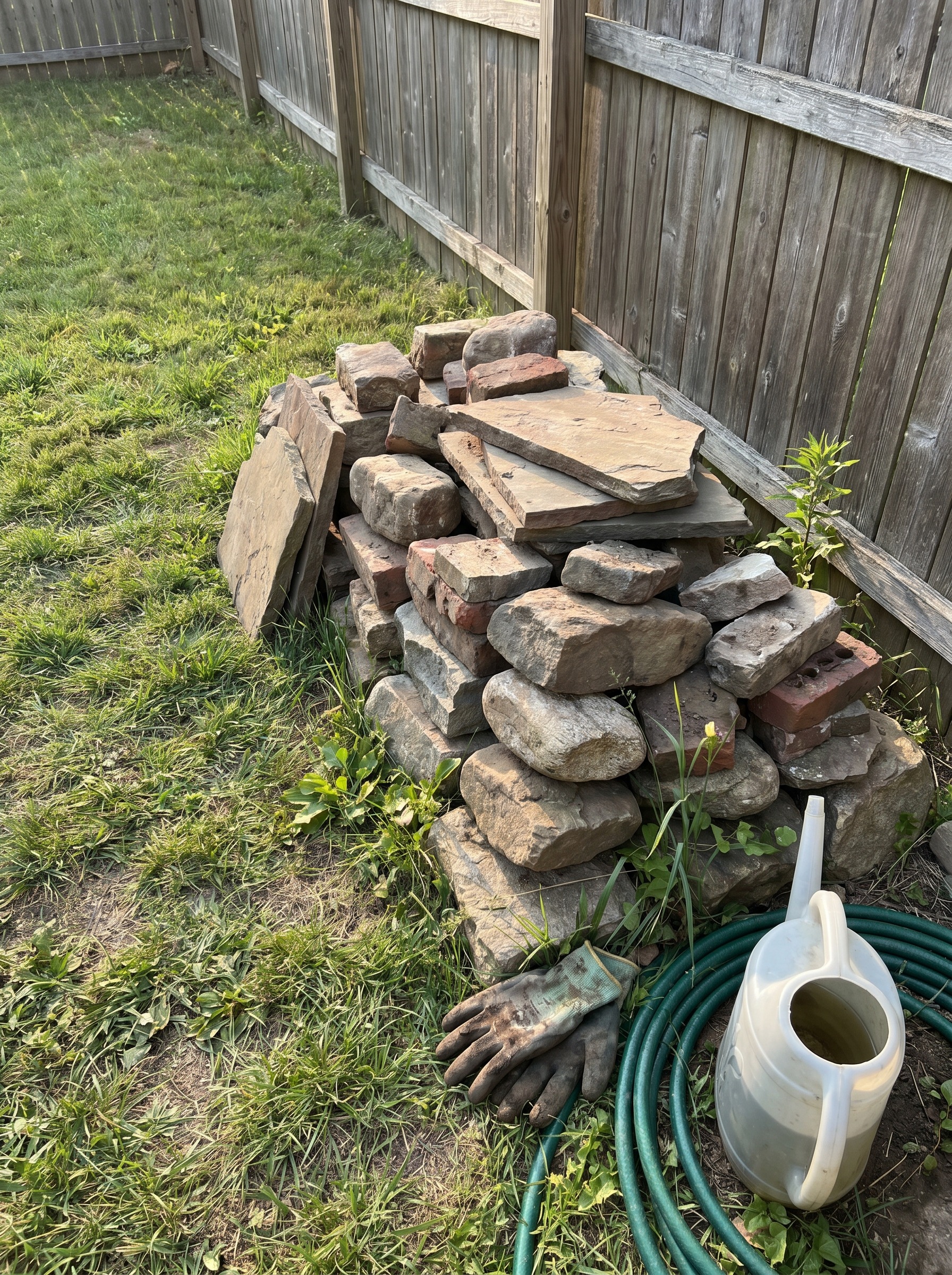
You do not need a $700 budget or a commercial contractor’s account to build a stone path. You just need a vehicle with a solid suspension and an eye for urban demolition. Homeowners pay thousands of dollars every year to have hardscape contractors haul away old stone, broken concrete, and fieldstone. Your goal is to intercept those materials before they hit the landfill.
Sourcing Slabs of “Urbanite” (Broken Concrete)
“Urbanite” is the landscape design term for salvaged pieces of broken concrete sidewalks, patios, and foundations. When turned upside-down or weathered, broken concrete looks almost identical to natural stackable limestone or grey sandstone, but it costs absolute zero dollars.
- Where to Look: Watch neighborhood Facebook Marketplace listings, CraigsList “Free” sections, and local Buy Nothing groups. Search for terms like “patio tear-out,” “concrete chunks,” “retaining wall removal,” or “free rock.”
- Target Thickness: Look for slabs between 2.5 inches and 4 inches thick. Anything thinner than 2 inches will crack under a loaded wheelbarrow. Anything thicker than 5 inches will weigh upwards of 90 pounds per square foot and ruin your back during transport.
- Evaluating Surface Texture: Avoid concrete slabs that have glossy sealant, tile adhesive, or painted tops. Standard unsealed brush-finish concrete or old aggregate concrete offers excellent grip when wet and ages into a gorgeous, lichen-covered natural look within two seasons.
Harvesting Native Fieldstone & River Rock
If you live in a region with rocky native soil (like the Northeast, Upper Midwest, or Pacific Northwest), farmers and suburban homeowners are constantly digging rocks out of their garden beds.
- Farmer’s Rock Piles: Drive around rural edges of your town in early spring. Farmers routinely clear rocks from fields and dump them at edge-lines. Always ask permission first—most farmers are thrilled to have someone haul away fieldstones from their property lines.
- Construction Excavation: When a new residential foundation is being dug nearby, contact the site manager. If you show up with heavy work gloves, steel-toed boots, and a heavy-duty pickup truck outside active working hours, they will often let you hand-load fieldstone straight out of the spoils pile.
Sourcing Safety & Vehicle Weight Limits
Do not wreck your commuter car to save $200 on stone. Stone is deceptively dense.
- Weight Math: A single cubic foot of solid rock or concrete weighs approximately 145 to 150 pounds. A standard 1/2-ton pickup truck (like an F-150 or Silverado) can safely carry around 1,500 to 1,800 pounds of payload in the bed. That means you can only haul roughly 10 to 12 cubic feet of stone per trip!
- SUV Limits: If loading into a mid-size SUV or hatchback, limit your load to no more than 600–700 pounds at a time (about 8 to 10 medium-sized flagstones) to avoid blowing out your rear shock absorbers and coil springs.
When I first started hauling raw stones from my neighbor’s yard, my hands paid the price within the first hour. I quickly learned that lightweight canvas gloves don’t cut it against jagged granite, which is why I now never lift a single rock without wearing Heavy-Duty Landscaping Work Gloves. They give you the grip you need for heavy lifting while completely saving your knuckles from scrapes.
This surprised me honestly: the mismatched look actually looks better in a cottage-style garden than perfectly uniform pavers. When you use cottage garden design principles, imperfection is actually a feature, not a bug.
4. Required Tools & Material Checklist
Before you start digging, assemble the proper equipment. Hardscaping with hand tools requires leverage, not brute force.
Essential Tools
- Flat-edge Trenching Shovel: Essential for cutting clean, straight edges along your turf line.
- Square-mouth Shovel: Used for clearing loose sub-soil out of the trench bottom.
- Hand Tamper (8×8 inch steel plate): Critical for compacting the aggregate base layer.
- 4-Foot Aluminum Spirit Level: Used to ensure the path sheds water away from house foundations.
- Dead-Blow Rubber Mallet (2-lb to 3-lb): For tapping heavy stones down into the sand bed without fracturing the stone.
- Heavy Duty Wheelbarrow: Dual-wheel models are vastly superior here—they won’t tip over when loaded with 200 pounds of wet concrete chunks.
- Pair of Heavy Leather Gloves: Raw concrete and dry fieldstone will tear through jersey cotton gloves in less than twenty minutes.
Base Materials (Per 100 Sq. Ft. of Path)
Coarse Masonry / Concrete Sand: 0.5 tons (Sharp, angular sand that locks together; do not use smooth play sand).
Commercial Woven Geotextile Fabric: 1 roll (minimum 4-mil thickness; avoid cheap non-woven landscape paper).
3/4-Inch Crushed Run / Dense Grade Aggregate: 1.25 tons (This is gravel mixed with fine stone dust; it compacts as solid as concrete).
Most gardening blogs never mention this: if you have a slope, mulch will wash away in a single heavy downpour. Stone stays. If you use watering plants correctly techniques like deep soaking, you want that water going to the roots, not washing your path material into the street.
5. Step-by-Step Installation: The Low-Stress Foundation
I tried the “pro” way once. Digging a six-inch trench, adding compacted gravel, then sand, then leveling. It took me three weekends and I hated every second of it.
Now? I use the “Dig-As-You-Go” method. It’s much more beginner-friendly.
- Layout: Lay the stones out on top of the grass first.
- Before you touch a shovel, you need a smart way to visualize the path’s curves without making permanent mistakes. I always lay out a flexible Heavy-Duty Garden Hose along the ground first to test the flow of the walkway, twisting and adjusting it until the stride feels completely natural.
- The Stride Test: Walk the path. If the stones are too far apart, you’ll feel like you’re doing parkour. If they’re too close, it looks cluttered.
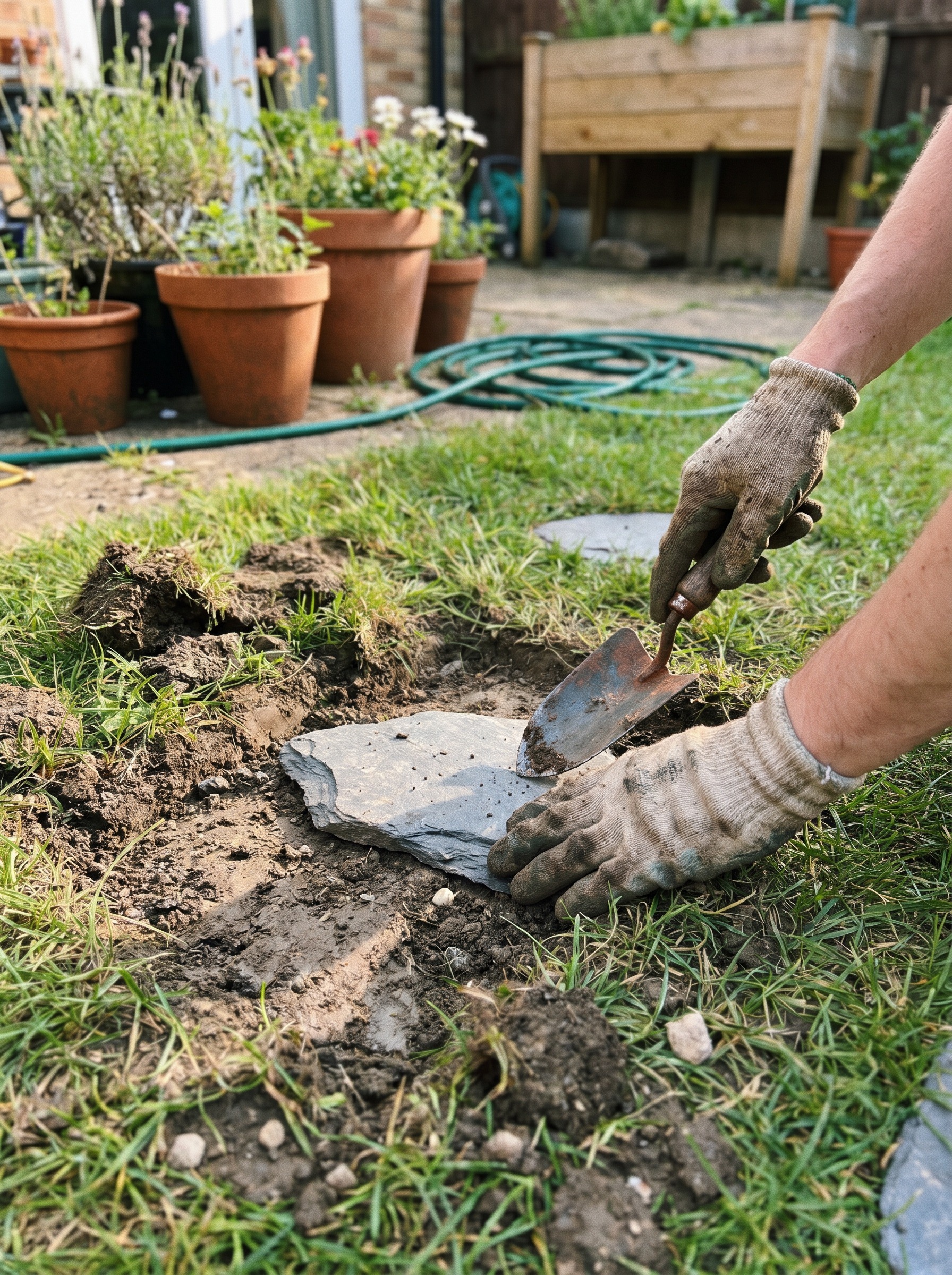
- The Cut: Use a sharp spade to trace the stone.
- Trying to cut clean, precise stone outlines with a standard rounded digging shovel is an absolute nightmare that usually ruins the surrounding turf. I highly recommend switching to an All-Steel Border Spade Shovel because the flat, razor-sharp blade lets you slice straight down into the grass like a knife through butter.
- The Lift: Move the stone, dig out the grass and about an inch of dirt.
- The Set: Put the stone back. It should sit slightly higher than the ground level to allow for settling.
I learned this the hard way: if you bury them perfectly flush with the dirt, the grass will grow over them in six months. Keep them about half an inch high.
6. Dealing with the “In-Between” Spaces
Once your stones are in, you have a choice. Do you let the grass grow between them? Or do you fill the gaps?
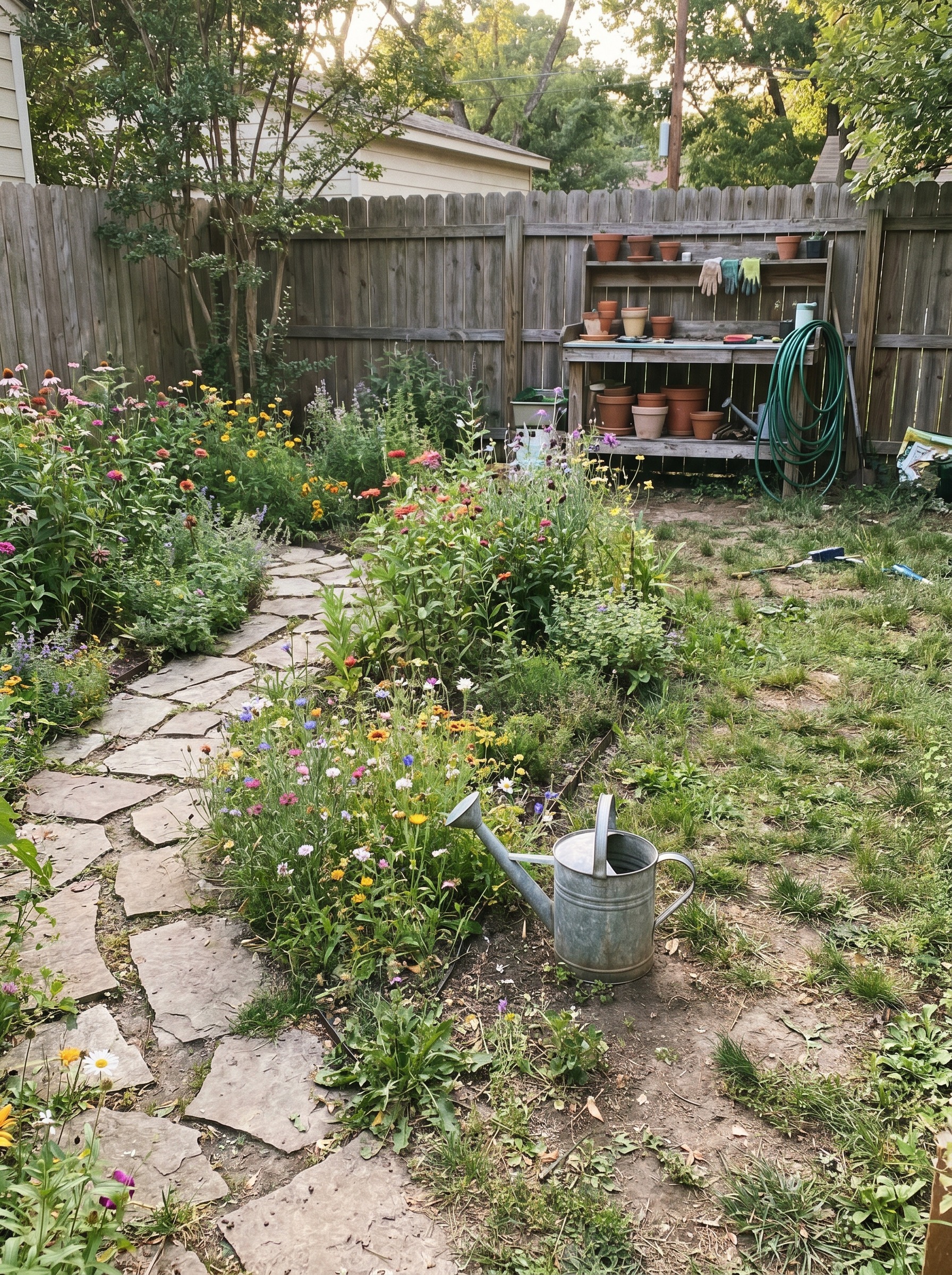
I’m a fan of the “living path.” If you have enough space between stones, you can plant creeping thyme or chamomile. It smells amazing when you step on it and helps choke out the weeds you actually don’t want.
If you prefer a cleaner look, use beginner gardening tips and fill the gaps with pea gravel or decomposed granite. It provides a nice color contrast and drains beautifully.
What Actually Works: The Foundation Guide
If you’re worried about stones shifting, here is the “Sprucetouch” secret to a stable path without the heavy machinery.
| Step | Action | Why it matters |
| 1 | Sand Base | Put a half-inch of leveling sand under each stone. |
| 2 | Heavy Stones | Use stones at least 1.5 inches thick. |
| 3 | Landscape Fabric | Only use it under the stones if using gravel fill. |
| 4 | Slope Check | Ensure the path tilts slightly away from your house. |
7. The Maintenance Reality Check
I’m not going to lie to you and say a stone path is zero maintenance. Nothing in a garden is.
Over time, dirt will blow into the cracks. Seeds will land there. You will get the occasional dandelion. But here’s why I prefer it to mulch:Eventually, stray weed seeds will find their way into the tiny crevices between your stones, but you don’t need to ruin your back pulling them or spray toxic chemicals near your plants. My favorite shortcut is using a Heavy-Duty Propane Weed Torch to safely blast the weeds at the root, which clears the entire path in just a few minutes. I’m not worried about “refreshing” the color or raking it back into place after a thunderstorm.
The best part? It looks better as it ages. Mulch looks its best on Day 1 and goes downhill from there. Stone looks better on Day 1,000.
8. Let’s Talk About “Urbandale” (Broken Concrete)
If you’re on a tight budget, look for “urbandale.” This is just broken-up sidewalk or driveway concrete.
When people tear out an old patio, they usually have to pay to haul the concrete away. If you offer to take it, you’re doing them a favor.
The secret to making concrete look like expensive stone? Flip it over. The bottom side usually has a beautiful, earthy texture from sitting in the dirt for decades. When you piece them together like a puzzle, most people won’t even realize it’s not natural flagstone.
9. Why “Lived-In” Beats “Perfect”
There’s a trend lately toward these hyper-perfect, laser-cut paver paths. They look like they belong in a shopping mall. In a real home garden, they often feel a bit “stiff.”
I’ve found that the more I embrace the slight imperfections—the stone that’s a little chipped, the brick that’s a different shade of red—the more the garden feels like a sanctuary.
When you stop trying to control every square inch, you start enjoying the process more. My stone path has grown with me. If I want to expand a flower bed, I just move a few stones. It’s a living, breathing part of the landscape.
Things That Didn’t Work for Me
I’ve made plenty of mistakes so you don’t have to.
- Using Smooth River Rocks for Steps: They are gorgeous, but they are death traps when wet. I once slid halfway across the yard because I used rounded stones on a slight incline. Stick to flat, textured stones for anywhere you actually need to walk.
- The “Tiny Stone” Regret: I thought using small, decorative white pebbles would look “Zen.” It just looked like a giant litter box for the neighborhood cats. Plus, the pebbles got stuck in the treads of my boots and I ended up scratching my hardwood floors inside.
- Forgetting the “Mower Test”: I once built a path with stones that stuck up about 3 inches. It looked cool until I realized I couldn’t get the lawnmower over it. I had to lift and reset 40 feet of stone.
Small Things That Make a Big Difference
- Solar Lights: Don’t overdo it, but tucking two or three low-profile solar lights near the curves makes the garden feel magical at night.
- Once the hard labor is done, adding a bit of ambient lighting completely transforms the space from a simple walkway into a stunning backyard feature. I tucked a few low-profile Low-Voltage Outdoor Solar Pathway Lights along the softest curves of my stone trail, and it now looks incredibly cozy after the sun goes down.
- The “Wobble” Fix: If a stone wobbles, don’t just keep adding dirt. Throw a handful of sand or stone dust underneath. It doesn’t compress like soil.
- If you just plop your stones directly onto uneven dirt, they are guaranteed to tilt and rock the second you step on them. To solve this, I always lift the wobbly stone and pack a handful of quick-draining Leveling Sand (0.5 Cu. Ft. Bag) underneath to create a rock-solid, perfectly flat foundation.
- Edge Plants: Plant something soft like “Lamb’s Ear” or “Lady’s Mantle” along the edges. It blurs the line between the hard stone and the garden, making it look much more professional.
FAQ: Common Stumbles for Beginners
In direct sun, dark stones can hold heat. If you live in a very hot climate, stick to lighter-colored stones like limestone or light granite.
If you just set stones on top of the grass, they will be unstable. You only need to dig down about 2 inches. It’s worth the 10 minutes per stone.
New construction sites (always ask first!), and people remodeling their patios. Most people are happy to let you haul away their “trash” rocks.
A thick layer of sand or a “polymeric sand” that hardens when wet is the pro way. The “lazy gardener” way is to just use a quick splash of boiling water on any stray weeds.
At the end of the day, your garden should be a place where you want to spend time, not a place that demands a constant subscription to the local nursery’s mulch pile. Moving to stone was one of the best decisions I made for my backyard.
Once you understand the basics of laying a solid foundation, the rest is just playing with heavy, beautiful puzzle pieces. Don’t worry about making it perfect. Just make it yours.
Most advice in this article comes from years of real gardening experience. Results may vary depending on climate. Always use caution when lifting heavy stones!

Aagam – Founder of SpruceTouch
I’m Aagam, a home and garden enthusiast who enjoys growing, building, and improving outdoor spaces. I focus on practical backyard projects, garden ideas, and simple DIY solutions that are useful in real homes. Through SpruceTouch, I share what I’ve learned, what worked, what didn’t, and the small details that can make an outdoor project easier.