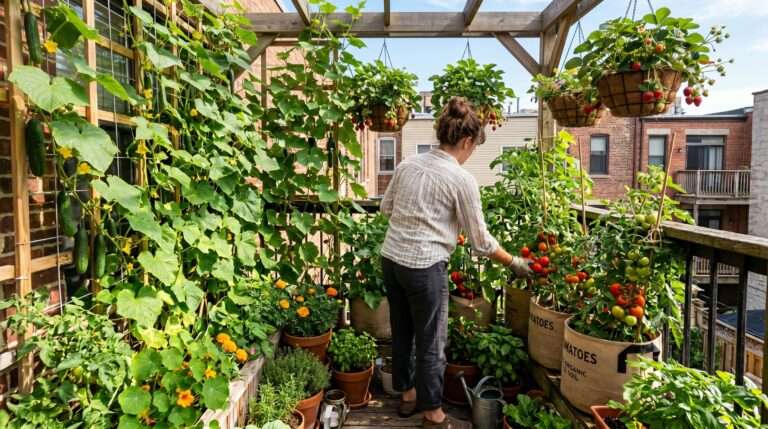
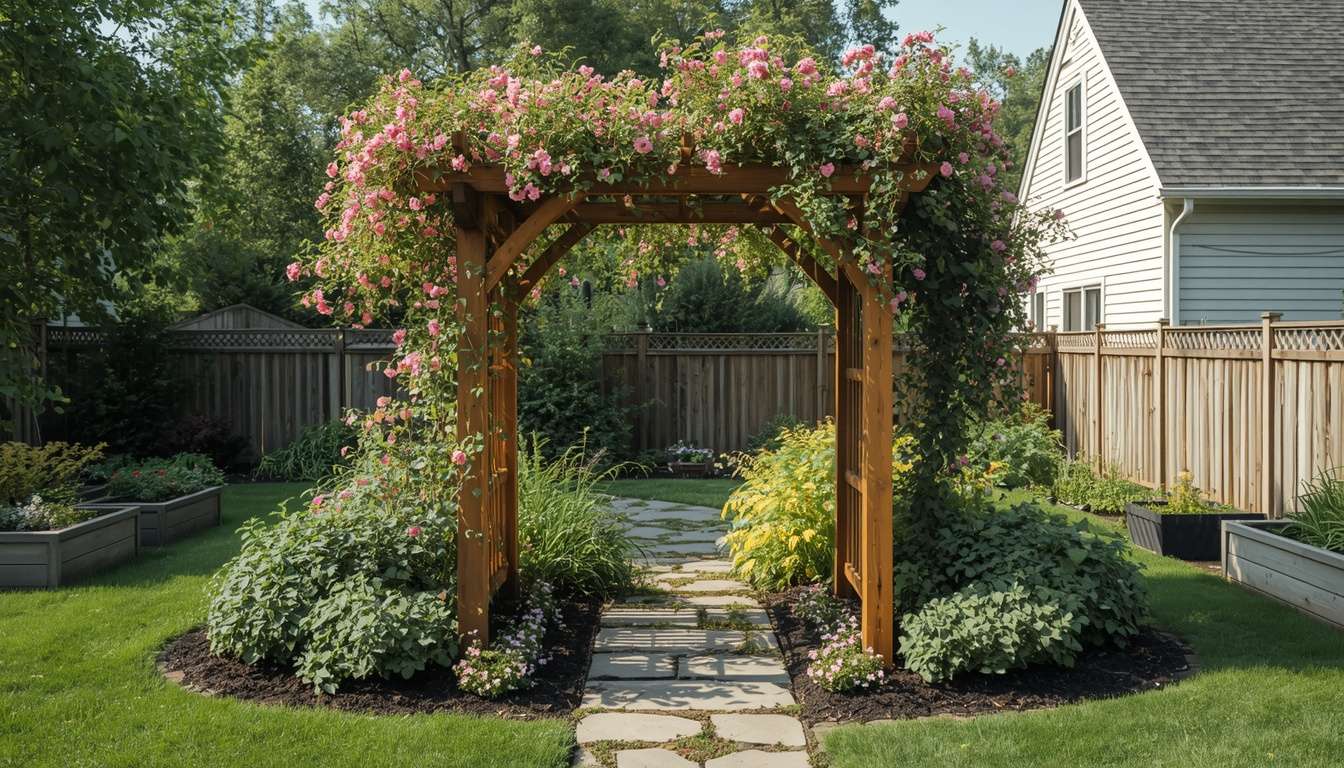
17 Genius Garden Trellis Ideas for Climbing Plants & Small Spaces
Before choosing a trellis: match the structure to the plant
One important detail often overlooked in trellis inspiration articles is that not every climbing plant climbs the same way. Morning glories and other twining vines wrap around supports, cucumbers use tendrils, and clematis climbs by wrapping its leaf stalks around narrow structures. Choosing the correct support makes a noticeable difference to how easily plants establish themselves.
When choosing a ready-made option for a narrow backyard, a Cedar Garden Lattice Trellis Panel is a practical starting point. Its open grid gives lighter climbing flowers room to weave through while creating a decorative backdrop behind a flower bed or patio planter. Cedar is a sensible wood choice for an outdoor structure, although it still needs appropriate installation and occasional maintenance.
Affiliate Disclosure: As an Amazon Associate, SpruceTouch earns from qualifying purchases. This post may contain affiliate links, which means we may earn a commission at no additional cost to you.
17 Genius Garden Trellis Ideas for Climbing Plants
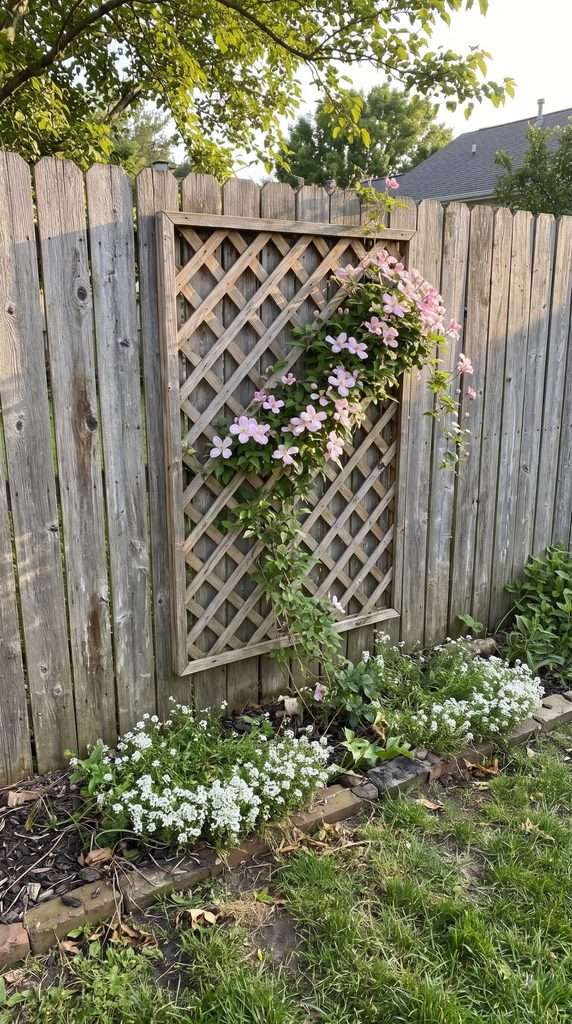
1. Classic Wooden Lattice Trellis Against a Backyard Fence
A simple wooden lattice trellis is one of the easiest ways to make an ordinary fence look more like a planted garden feature. The crisscross pattern creates plenty of small openings for climbing stems, and the wooden frame adds warmth even before the plants fill in.
You can purchase a ready-made lattice panel or build one using narrow cedar or weather-resistant wood strips. Attach it to properly positioned posts or a suitable independent frame rather than assuming an existing fence can support additional plant weight.
Clematis, annual sweet peas, and other relatively light climbers can work well here. Keep the trellis slightly away from the fence where possible so air can circulate behind the foliage.
It is also a useful way to visually improve an older fence without replacing the entire structure. Pair it with low-growing flowers or a narrow border of foliage plants to create a more finished look.
2. DIY Cattle Panel Garden Trellis Arch
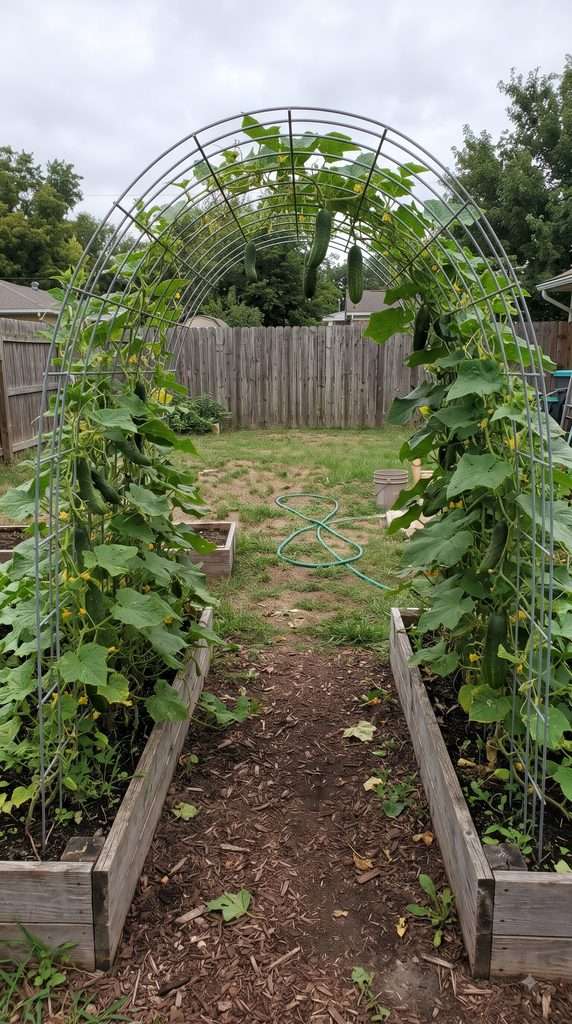
A cattle-panel arch is one of the most useful ways to combine vertical gardening with an attractive backyard walkway. Instead of allowing climbing plants to spread across a vegetable bed, you bend a suitable welded-wire panel into an arch and secure its sides to stable supports.
The result creates a green tunnel that can eventually become covered with foliage, flowers, or vegetables.
For a DIY version, look for Galvanized Welded-Wire Cattle Panel with 4-Inch Openings. Choose a panel that can be safely handled and bent for your intended span. Secure it to sturdy supports rather than relying on loose stakes.
Cucumbers, pole beans, and ornamental vines can all work depending on the panel’s dimensions and strength. For fruiting vegetables, choose a mesh opening that makes harvesting manageable.
A useful design variation is to position the arch between two raised beds. The plants grow overhead while the soil underneath remains available for other crops.
Your existing DIY Cattle Panel Garden Trellis Arch article is a particularly relevant companion for readers who want to build the structure rather than simply use it as inspiration.
One practical consideration: the finished arch is a plant support, not a walking structure designed to carry a person’s weight. Anchor it securely and avoid creating sharp exposed wire ends.
3. A-Frame Trellis for Cucumbers and Climbing Vegetables
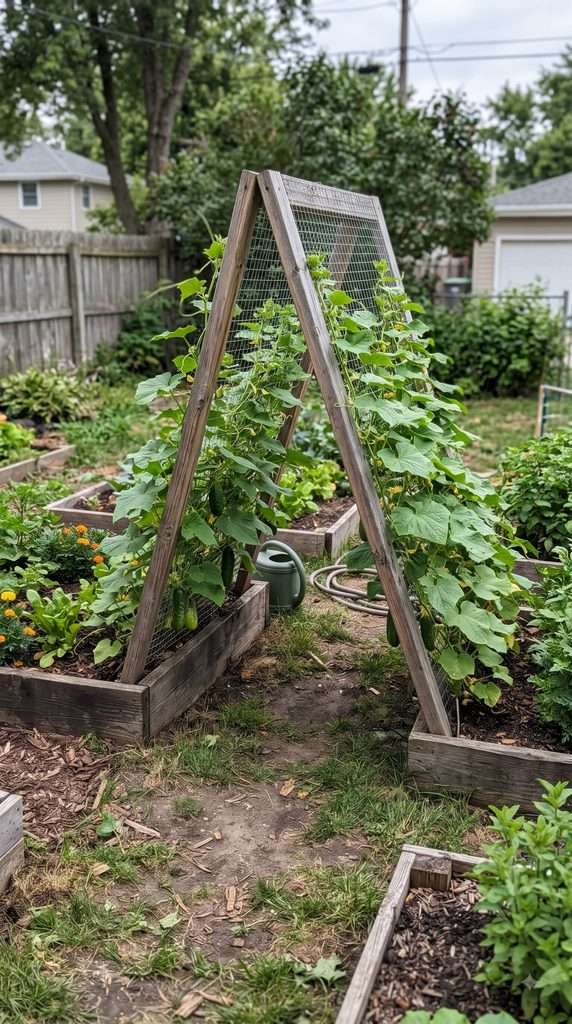
An A-frame trellis is a clever choice when you want to grow more vegetables without making a garden bed wider. Two sloping frames meet at the top, leaving a triangular growing space beneath them.
You can construct one from ordinary wood battens and attach garden mesh or welded wire to both sides. The frame can sit directly beside a raised bed or over a narrow vegetable planting area.
Cucumbers and smaller vining squash varieties are particularly suitable candidates, provided the framework is strong enough to carry the mature plants and developing fruit. Larger or heavier squash may need additional support for individual fruits.
The sloped sides also make it easier to reach the plants than a dense vertical wall of foliage.
For another way to use limited growing space, connect this idea naturally with your Vertical Vegetable Garden Ideas for Small Balconies guide.
4. Bamboo Teepee Trellis for Morning Glory
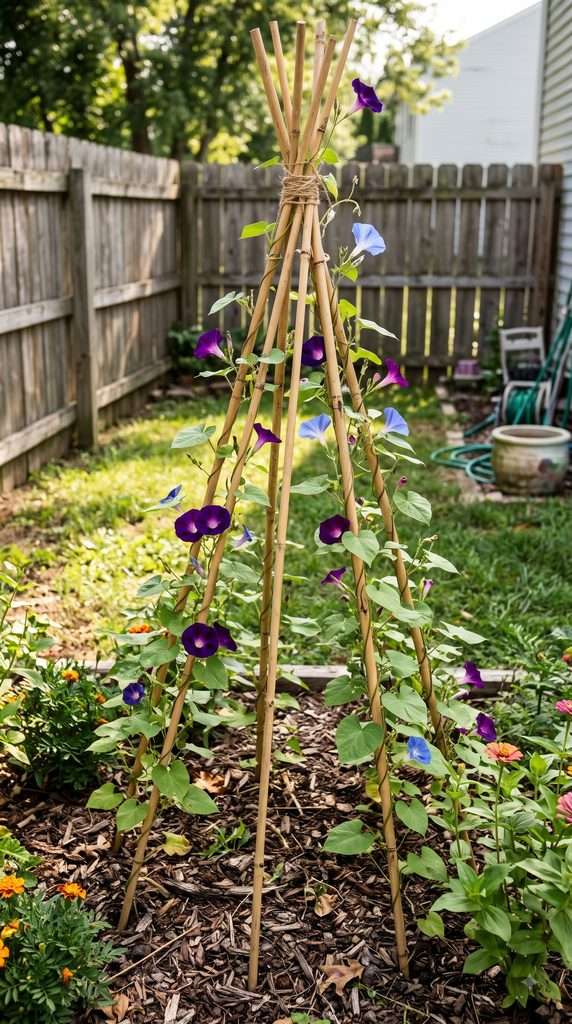
A bamboo teepee is one of the most affordable trellis ideas for a backyard, especially when you already have bamboo stakes available.
Arrange several long bamboo poles in a circle, bring their tops together, and tie them securely with garden twine. The structure should have a wide enough base to stand firmly once the vines begin climbing.
This design works beautifully for annual morning glory, hyacinth bean, and other twining vines.
Morning glory is especially attractive because its trumpet-shaped flowers can turn a simple support into a colorful focal point. It needs a support in place from the beginning rather than being left to sprawl across nearby plants.
Annual morning glory can grow quite vigorously, with some cultivars reaching approximately 15 feet. Choose the height of your support accordingly, and give the plant sufficient sunlight. One safety detail worth remembering: morning glory seeds can be toxic if swallowed. Keep seed packets and collected seeds away from children and pets. Also check local guidance about reseeding before choosing a variety.
5. Minimalist Wall-Mounted Wire Trellis
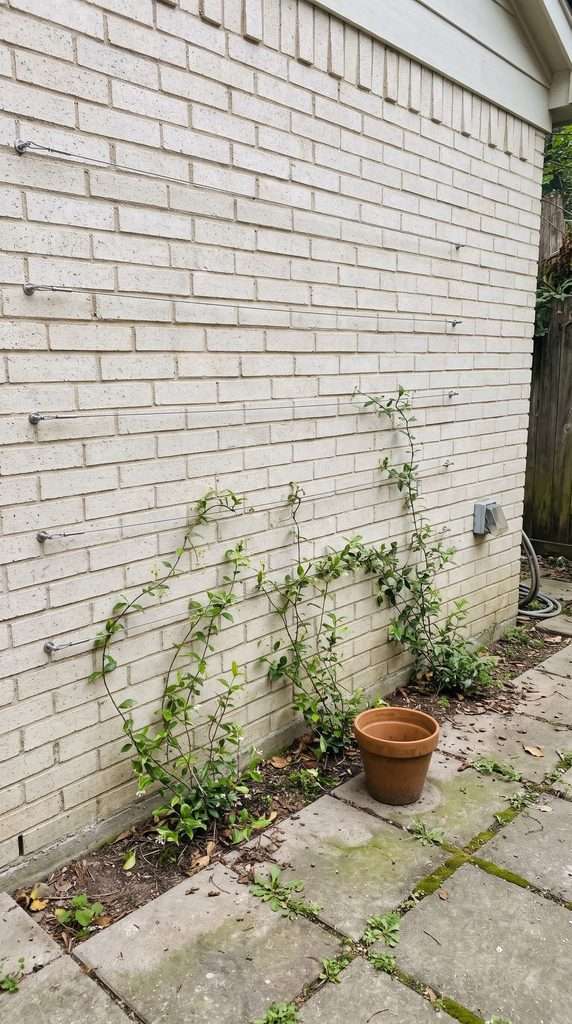
Not every trellis needs a bulky wooden frame. A wall-mounted wire system creates a cleaner appearance and works particularly well in narrow courtyards, along brick walls, and beside small patio seating areas.
The idea is simple: install suitable wall anchors and horizontal or vertical tensioned wires to create a climbing framework. The plant gradually fills the open space while the support remains visually subtle.
A Stainless Steel Wire Trellis Kit with Turnbuckles and Eye Screws can make this style easier to assemble because the system is designed around tensioned cable and mounting hardware.
Choose the wall carefully. Brick or masonry can be suitable when the correct anchors are used, but avoid allowing clinging vines to attach directly to wooden siding. Missouri Extension recommends keeping supports away from wood siding and allowing airflow behind the foliage.
This system is particularly attractive with lighter vines such as clematis or jasmine. Check plant requirements and local climate before selecting a variety.
6. Repurposed Wooden Ladder Trellis
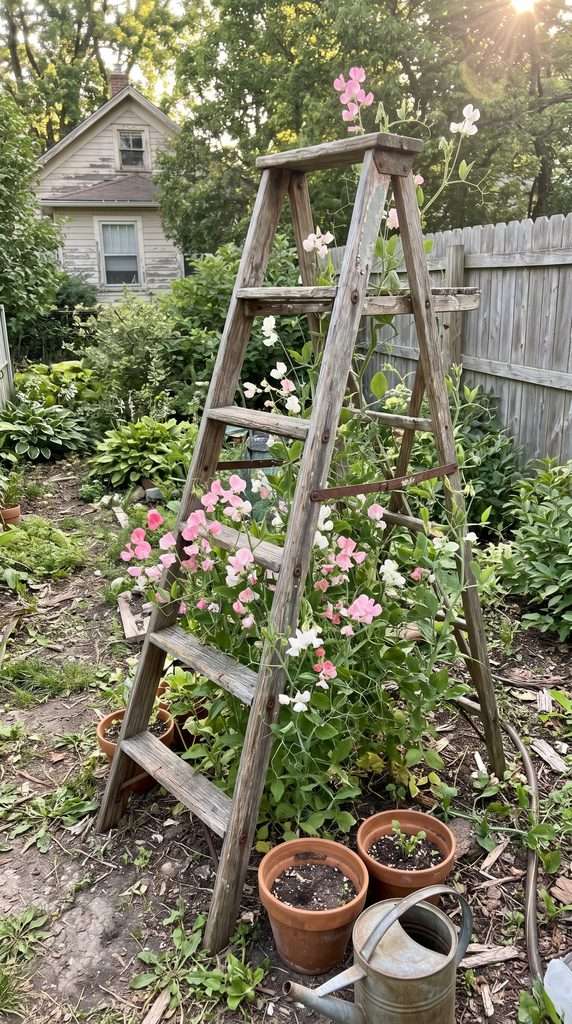
Have an old wooden ladder that is no longer suitable for regular use? Rather than sending it straight to the scrap pile, consider turning it into a decorative garden trellis.
An open-sided ladder offers several horizontal rungs where lighter vines can be guided as they grow. Place it in a flower border or beside a large outdoor container, making sure it is stable and cannot fall over.
Sweet peas and other lightweight climbers are a nice match. You can also position small pots at its base to create a layered garden display.
Check the ladder for splinters, cracks, loose joints, and deteriorating coatings before using it. Avoid ladders with peeling paint or unknown finishes that could contaminate growing soil.
This is a particularly good example of cheap trellis ideas for backyard spaces because the main structure may already be sitting in your garage or shed.
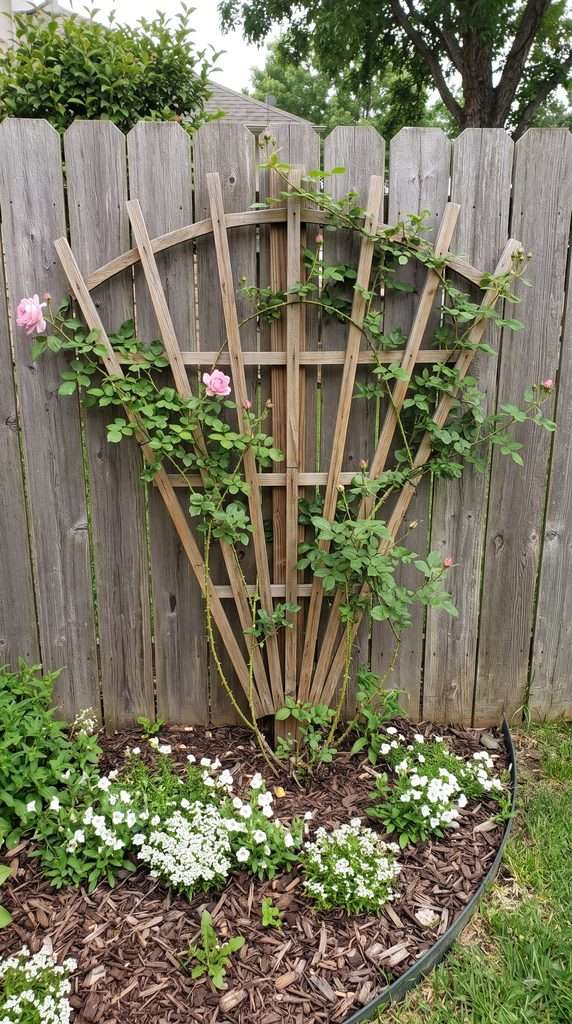
7. Fan-Shaped Trellis for Climbing Roses
A fan-shaped trellis is a lovely option when you want a decorative feature without using much ground space.
Its narrow bottom spreads into a wider upper frame, allowing climbing stems to be trained outward rather than growing into one crowded bundle.
Place the structure near a fence, garden wall, or the back of a flower bed. Climbing roses, lighter clematis varieties, and other suitable trained vines can benefit from this spreading arrangement.
As new stems grow, guide them along the fan rather than pulling mature branches into position. Use Reusable Soft Garden Tie Tape to attach stems loosely, leaving room for normal growth.
A good-looking rose trellis also needs enough clearance for pruning and air circulation. Avoid tying stems so tightly that they rub against the framework.
For a more complete fence-side planting scheme, consider pairing this structure with the ideas in Best Plants for Fence Lines.
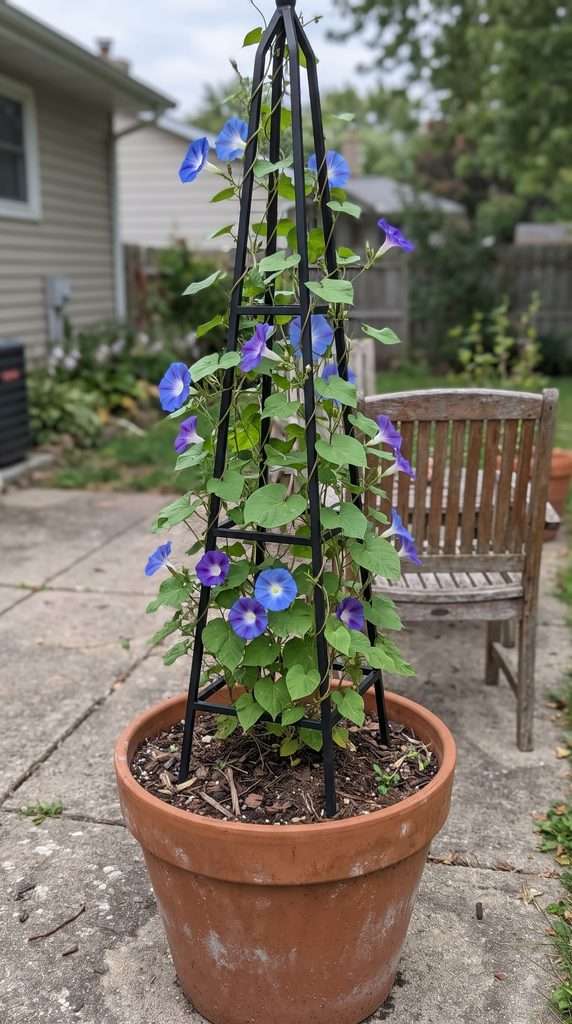
8. Decorative Obelisk Trellis for Pots and Small Gardens
If you have a small patio or only a few square feet of planting space, a vertical obelisk can provide an attractive climbing support without requiring a permanent garden structure.
An obelisk is usually a tall, tapered frame with several upright supports and horizontal connecting pieces. It works particularly well in a large container or in the center of a compact flower bed.
Morning glory, cardinal climber, and other annual vines can use this shape when the individual openings are appropriate for their climbing habits.
One important detail is container stability. A tall vine catches the wind, so a lightweight planter can become top-heavy. Choose a sufficiently large, stable container and insert the trellis legs firmly into the potting medium before planting.
Container-grown climbers also need consistent attention to watering because their growing medium can dry out faster than surrounding ground soil. Illinois Extension recommends sizing container supports to the eventual vigor of the vine and positioning the support before planting.
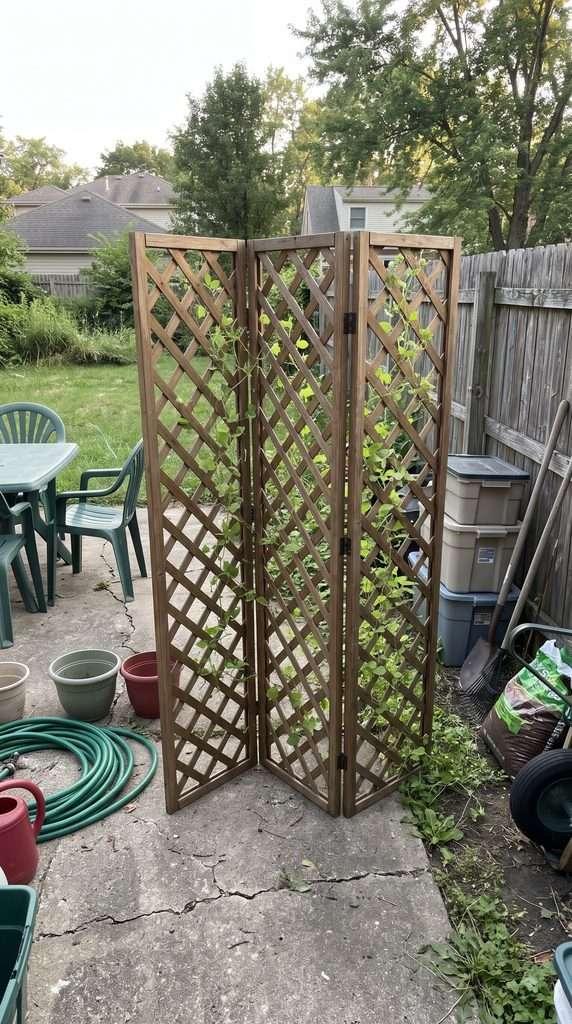
9. Folding Trellis Screen for Flexible Backyard Privacy
A folding trellis screen is useful when you need a little separation between outdoor areas but do not want to construct a permanent fence.
The accordion-style framework can be opened or adjusted to fit different spaces. Position it beside an outdoor dining area, hide an untidy storage corner, or create a softer boundary around a patio.
Lightweight annual vines can gradually cover the openings, making the screen feel more like a living divider.
This idea is particularly suitable for homeowners who like changing their backyard layout between seasons. A freestanding version can also be moved when the plants are dormant, although an established vine may make relocation difficult.
Remember that a folding frame is not automatically stable in wind. Secure it properly and avoid using it as a substitute for a structural privacy fence.
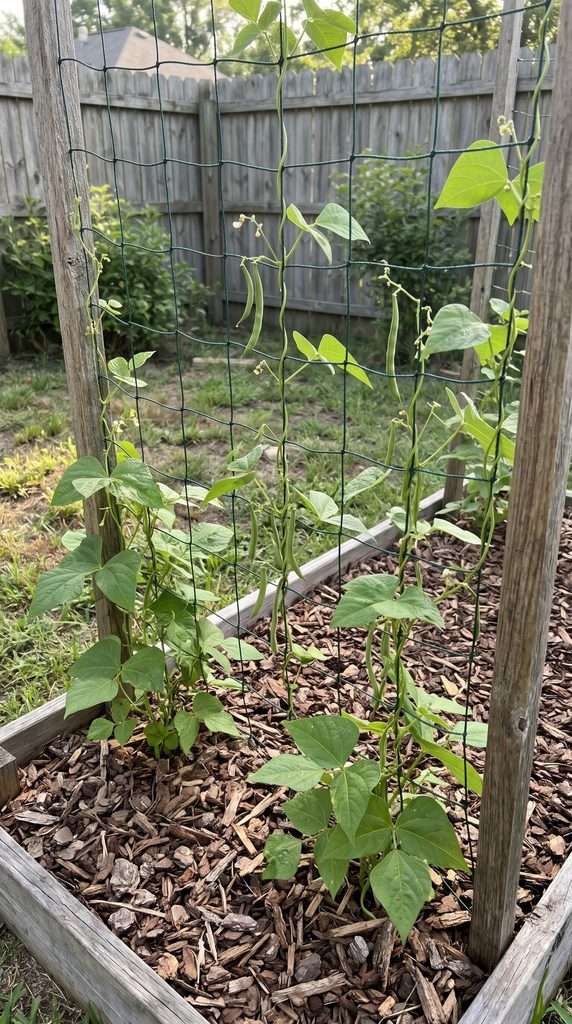
10. Vertical Garden Netting for Beans and Cucumbers
Sometimes the best trellis is also the simplest. Garden netting stretched between two sturdy vertical posts can create an inexpensive growing wall for climbing vegetables.
The system is especially useful for pole beans, peas, and cucumbers that can grip or wind through an appropriate mesh.
Use Heavy-Duty Garden Trellis Netting, Approximately 6 × 8 Feet when you want a lightweight framework that can be cut or arranged to fit a particular garden bed. Check the mesh size and strength before purchasing, especially for vigorous plants.
Attach the netting evenly rather than allowing it to sag in the middle. The lower edge should also be positioned so that plants can reach the mesh as they grow.
The biggest advantage is flexibility. Once the growing season ends, some lightweight netting systems can be removed and stored, depending on the material and condition.
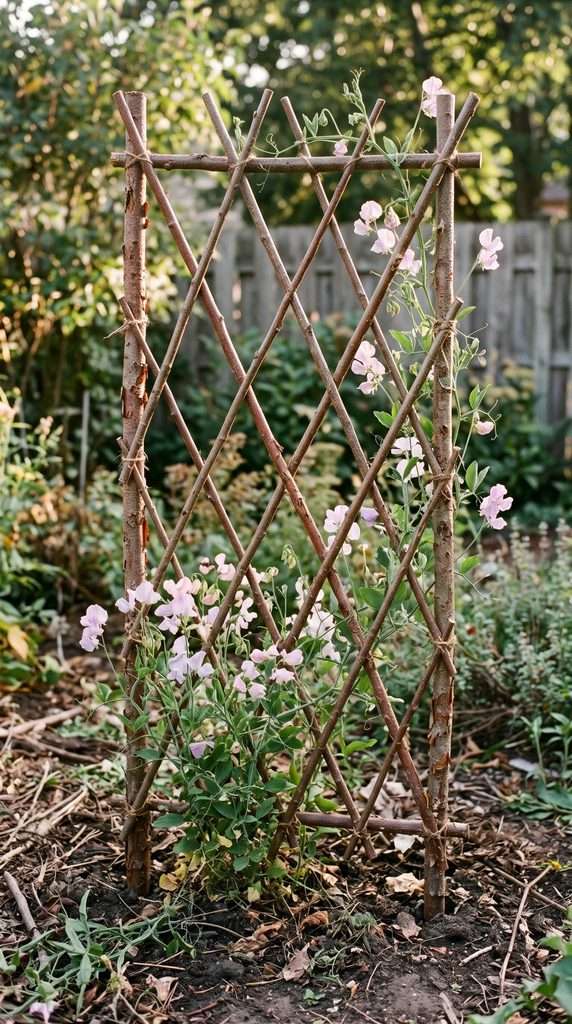
11. Rustic Willow Branch Trellis
If you prefer a softer, natural-looking garden, a willow branch trellis is worth considering.
Flexible branches can be woven between upright sticks to create an informal grid. The structure may look slightly uneven, but that is part of its appeal in cottage-style flower beds.
Use straight, reasonably sturdy branches for the sides and smaller flexible pieces for the woven pattern. Secure the intersections with natural garden twine.
Light climbers such as sweet peas can add flowers without overwhelming the structure. Heavier vines may require a stronger wooden or metal framework.
Freshly cut branches can bend more easily than completely dried ones, although durability depends on the wood and weather exposure. Treat this as a seasonal or decorative support rather than a permanent heavy-duty installation.
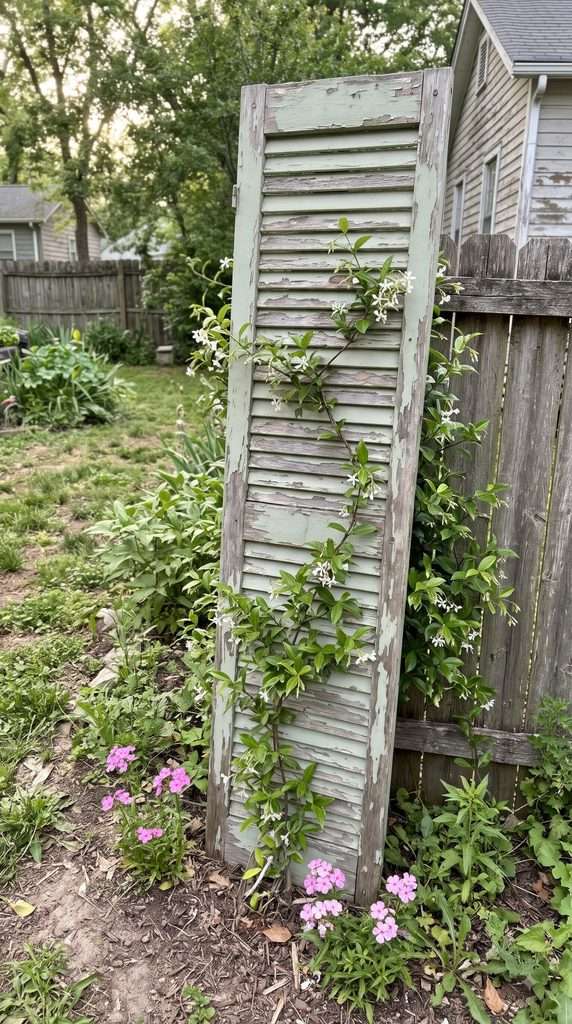
12. Reclaimed Wooden Shutter Trellis
Old wooden shutters can make surprisingly attractive garden supports.
Their horizontal slats provide a ready-made framework for guiding plant stems, while the vertical sides make the structure easy to position in a narrow bed.
Before reusing a shutter, check its condition carefully. Avoid peeling paint, damaged timber, and unknown coatings that may not be suitable around garden soil.
A weather-resistant shutter can be painted or left naturally aged to complement the garden. Place it on a stable support so it does not lean dangerously as vines become heavier.
This idea suits lighter climbing flowers and decorative foliage, particularly in cottage-style gardens where reclaimed materials feel appropriate.
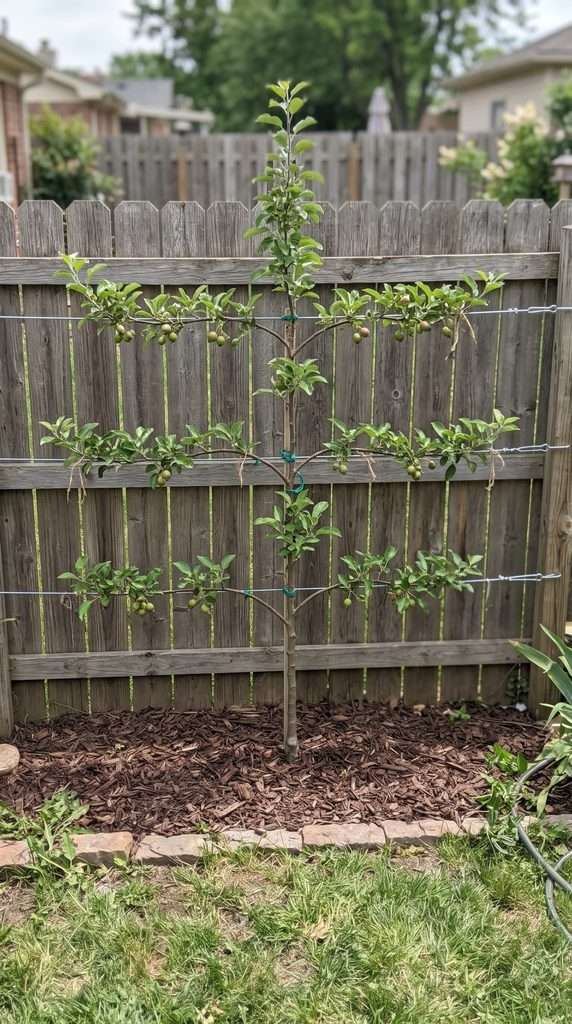
13. Espalier-Style Fruit Tree Trellis
An espalier trellis is a more structured option for homeowners who want to grow fruit trees in a narrow space.
Instead of allowing the tree to develop a fully rounded canopy, selected branches are trained along horizontal support lines. The result is a flatter growing shape that can fit against a suitable wall or fence-side framework.
Young apple and pear trees are commonly used for this style, although suitability depends on the variety and rootstock.
This is not a quick weekend decorating project. The framework should be installed before the tree is trained, and the branches need regular pruning and careful ties as they develop.
A properly planned espalier can make an otherwise difficult strip of garden productive, but it requires more ongoing attention than an ordinary ornamental trellis.
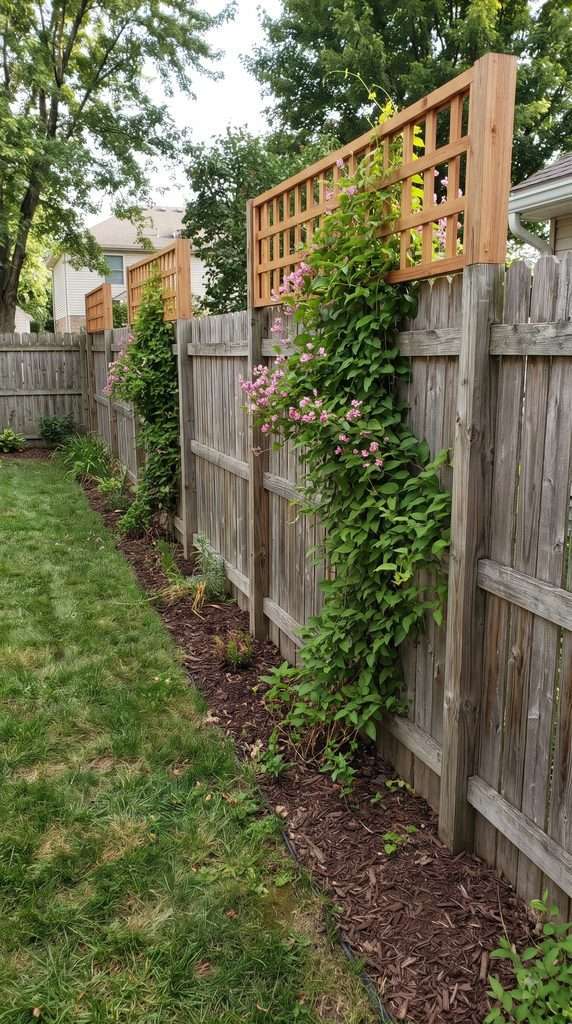
14. Narrow Fence Extension Trellis for Vertical Privacy
A fence extension trellis is useful when you want additional greenery and a little more visual separation without making the entire yard feel boxed in.
Rather than replacing your existing fence, add a separate lattice section or suitable trellis panels above selected portions of the garden boundary.
This creates a more layered appearance and gives climbing plants a place to grow.
Use it for lighter flowering vines, depending on your local climate and the support structure. Keep in mind that adding a tall, dense screen can change how wind acts on the fence, so the existing fence and supports must be suitable for the added exposure and weight.
The design can be especially effective along a narrow side yard where there is little room for shrubs. For a broader range of fence styles, link naturally to Modern Fence Design Ideas for Privacy and Backyard Style.
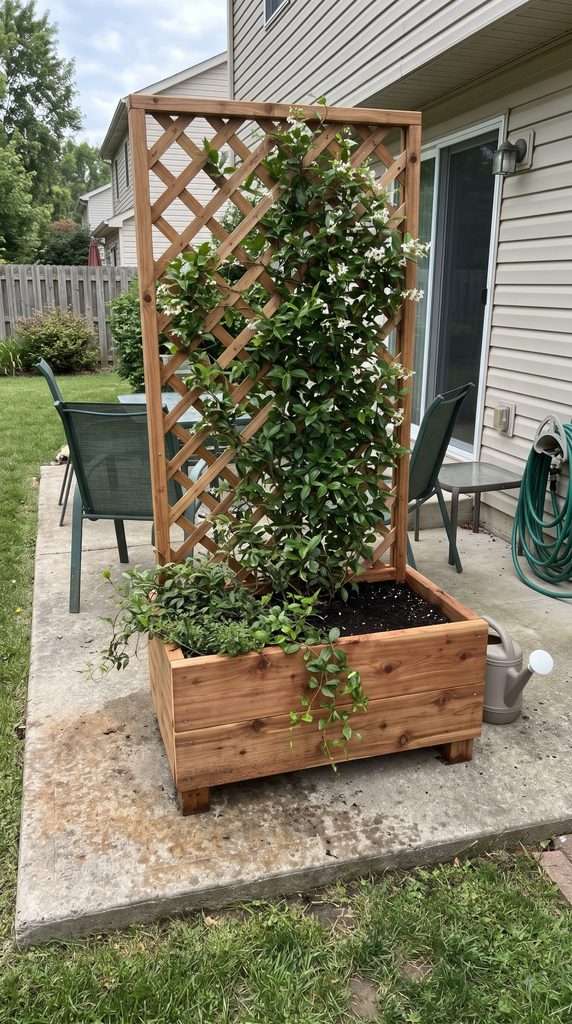
15. Wooden Trellis Planter Box Combination
A trellis planter combination is one of the best ways to add vertical greenery to a patio where there is no garden bed available.
The design combines a raised planter box with an upright framework attached to its rear. The container holds the plant, while the trellis provides vertical support.
It can also work as a decorative divider between seating and dining areas.
The planter needs sufficient growing depth for the chosen plant and proper drainage. The trellis should be firmly attached to the frame rather than relying on loose support poles inserted into shallow potting soil.
For a DIY version, Exterior-Rated Deck Screws for Outdoor Wood Projects are a useful hardware category to consider when joining appropriate outdoor lumber. Select fasteners compatible with the wood and any treatment or coating, and follow the manufacturer’s installation guidance.
You can leave the wood natural, use an appropriate exterior finish, or paint it to match existing patio furniture.
16. Straight Galvanized Wire Panel Trellis
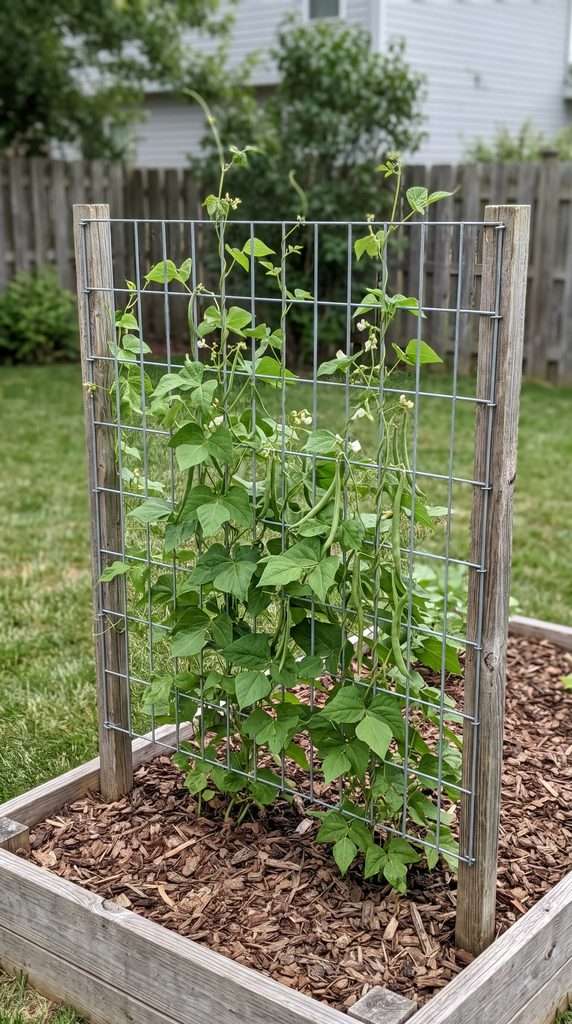
A straight welded-wire panel is a practical alternative when you do not need a curved arch.
Install a suitable section between two sturdy posts and position it beside a planting bed. The open grid provides plenty of room for vines to spread while keeping the overall structure visually light.
This is a particularly useful design for pole beans, peas, and some smaller-fruited climbing vegetables.
Compared with a solid wooden panel, a wire framework can allow more light and airflow through the growing area. However, choose corrosion-resistant material and check the edges for sharp wire ends before installation.
You can also position several panels along a longer vegetable bed rather than creating one enormous structure.
The main benefit is practicality: the support does not take up much additional ground space and can be reused for different crops from season to season.
17. Small Garden Pergola-Style Trellis Walkway
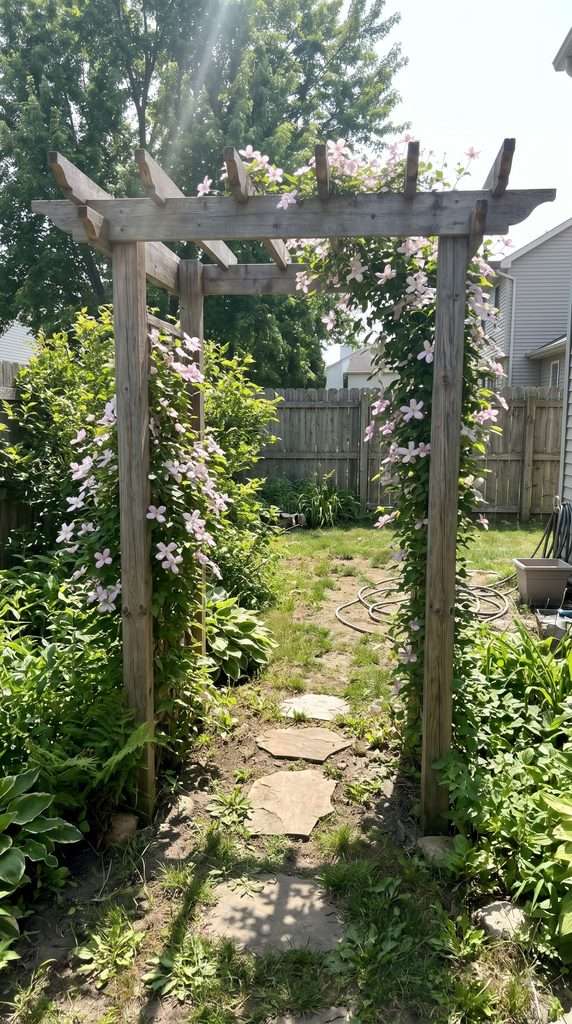
A small pergola-style trellis walkway can turn an ordinary path into a more defined garden feature.
You do not need a large outdoor structure for this effect. A narrow overhead framework supported by properly installed posts can create a simple transition between two garden areas.
Train lighter flowering climbers along the sides and across suitable overhead supports. Clematis and appropriately selected climbing roses can soften the timber framework with seasonal flowers.
The important thing is to distinguish an ornamental garden arch from a structural pergola. A full overhead structure must be designed and anchored for its actual loads, including mature plant growth, wind, and applicable snow conditions. Do not assume a lightweight decorative arch can safely support a heavy mature vine.
This design is particularly useful for creating a natural transition between a patio and a flower garden.
How to Choose the Right Trellis for Your Climbing Plants
Choosing a design based only on appearance can lead to disappointment. A structure that looks beautiful in a photograph may not provide the support your particular plant needs.
Here are a few practical considerations.
Match the support to the climbing habit
| Climbing plant type | Suitable support |
| Twining vines, including morning glory | Bamboo, narrow wire, lattice, obelisk |
| Tendril climbers, including cucumbers and peas | Netting, mesh, welded wire |
| Clematis | Narrow lattice, wire, fine-gauge framework |
| Climbing roses | Strong fan trellis, wooden support, wire framework |
| Grapes | Heavy-duty posts and wire system |
These are general design suggestions. The plant’s mature size and the strength of its stems should determine the final structure.
Think about the amount of space available
A narrow backyard does not necessarily need a wide trellis.
A vertical wire system, narrow wooden lattice, or wall-mounted frame can provide more growing room without taking up much usable ground space.
For patios and balconies, an obelisk or integrated planter trellis is often easier to manage than a permanent garden arch.
Choose materials that suit outdoor conditions
Cedar, redwood, and cypress are commonly considered suitable outdoor wood choices. Galvanized metal and appropriate exterior-grade hardware can also be useful.
The right material depends on the intended lifespan, weather exposure, maintenance requirements, and plant weight. Missouri Extension discusses the durability of suitable woods and metal supports in its ornamental vine guidance.
Install the structure before the plant becomes large
This is particularly important with climbing flowers and vegetables. Large trellises and arches should be installed before planting where possible. Smaller supports are best positioned when the plants are young. Secure the structure firmly enough to resist mature foliage and wind exposure.
Common Garden Trellis Mistakes to Avoid
A trellis does not have to be complicated, but a few planning mistakes can create unnecessary maintenance.
Choosing a support that is too small: A fast-growing vine may cover a short frame quickly. Check the mature growth habit before purchasing or building the structure.
Using the wrong mesh spacing: Very wide openings may not give small tendrils enough to grip, while very small openings can make training and removal difficult.
Attaching vines directly to wooden siding: Some clinging vines can hold moisture against the surface. Use an appropriate separate support and provide ventilation instead.
Forgetting stability: An attractive trellis can become unstable as foliage develops. Secure its base and consider how wind acts on the completed plant-covered structure.
Tying stems too tightly: Soft ties should hold plants in position without cutting into developing stems. Check them as the plant grows.
Ignoring maintenance: Vines need occasional pruning, training, and removal of dead growth. A completely neglected trellis can become tangled and difficult to maintain.
Frequently Asked Questions About Garden Trellises
Bamboo stakes, reclaimed wooden ladders, leftover lumber, and suitable garden twine are among the inexpensive options. For a more permanent structure, reused wood or a suitable wire panel may be worthwhile.
A bamboo teepee, obelisk, wooden lattice, or narrow wire framework can work well. Morning glory is a twining vine, so it needs support that its stems can wrap around. Some varieties grow vigorously, making sufficient height important.
Absolutely. Vertical supports allow plants to use overhead growing space instead of spreading across the ground. Narrow wall trellises, folding screens, and compact obelisks are especially useful.
It depends on the plant. A compact container climber may need only a short obelisk, while vigorous annual morning glory can require a considerably taller support. Check the mature height of the selected cultivar before building.
Cedar and other suitable durable woods, galvanized metal, and appropriate wire systems are common choices. Consider weather exposure, plant weight, maintenance, and how long you want the structure to last.
It can be positioned against a suitable fence, but leaving some space behind the framework can improve ventilation and make maintenance easier. For wooden house siding, provide a separate support with sufficient clearance to help prevent moisture problems.
Yes. Cucumbers and some pole beans are good candidates. Make sure the arch is sufficiently strong, the mesh is appropriate for the crop, and the planting arrangement allows you to reach and harvest the vegetables.
A garden trellis is more than a place for climbing plants to grow. It can add height, create privacy, improve the appearance of a fence, and make a small backyard more productive.
For a budget-conscious project, a bamboo teepee, recycled ladder, or simple netting support is a good place to start. For a more noticeable backyard improvement, a cattle-panel arch or wooden lattice can create a stronger visual feature.
The most important decision is to choose the right structure for the plant rather than choosing a plant to fit an unsuitable structure. Plan for mature growth, install the support securely, and leave enough room for pruning and harvesting.
Transparency Note: This article draws on university extension guidance, established gardening practices, and practical DIY considerations. The suggested trellis designs are inspiration and planning concepts, not personally tested or structurally certified building plans. Adapt materials, anchoring, and plant choices to your local conditions.

Aagam – Founder of SpruceTouch
I’m Aagam, a home and garden enthusiast who enjoys growing, building, and improving outdoor spaces. I focus on practical backyard projects, garden ideas, and simple DIY solutions that are useful in real homes. Through SpruceTouch, I share what I’ve learned, what worked, what didn’t, and the small details that can make an outdoor project easier.